A Levels Chemistry (9701)•9701/13/M/J/25
A Levels Chemistry (9701) — 9701/13/M/J/25, Question 10
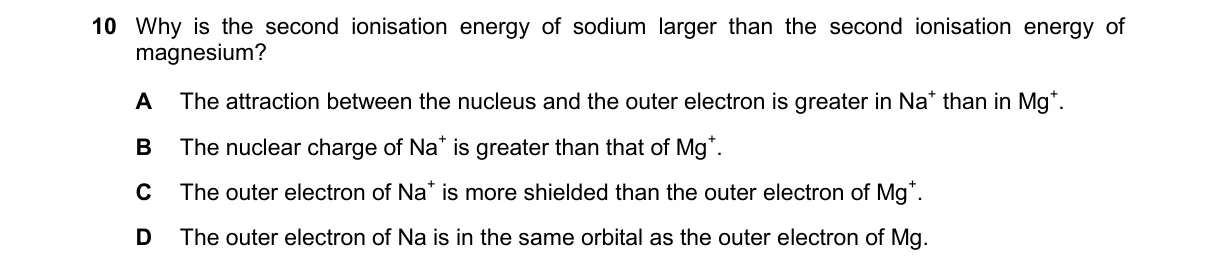
Why is the second ionisation energy of sodium larger than the second ionisation energy of magnesium?
Answer choices
- AThe attraction between the nucleus and the outer electron is greater in Na than in Mg
- BThe nuclear charge of Na is greater than that of Mg
- CThe outer electron of Na is more shielded than that of Mg
- DThe outer electron of Na is in the same orbital as the outer electron of Mg
Explanation
Electron Shell Differences After First Ionization
Steps:
- Sodium (Z=11) configuration: [Ne] 3s¹; first ionization yields Na⁺ ([Ne], n=2 shell filled).
- Magnesium (Z=12) configuration: [Ne] 3s²; first ionization yields Mg⁺ ([Ne] 3s¹, n=3 shell).
- Second ionization of Na removes a 2p electron (n=2, closer to nucleus).
- Second ionization of Mg removes a 3s electron (n=3, farther from nucleus), requiring less energy due to weaker attraction.
Why A is correct:
- In Na⁺, the outer electron is in the n=2 shell, experiencing stronger nuclear attraction per Coulomb's law (F ∝ 1/r²) compared to the n=3 electron in Mg⁺.
Why the others are wrong:
- B: Na nuclear charge (Z=11) is less than Mg (Z=12), so this reverses the trend.
- C: The 2p electron in Na⁺ has less shielding (inner shell) than the 3s electron in Mg⁺ (shielded by n=2 electrons).
- D: Na⁺ outer electron is in 2p orbital (n=2); Mg⁺ is in 3s (n=3), different principal quantum numbers.
Final answer: A
Topic: The Periodic Table: chemical periodicity
Practice more A Levels Chemistry (9701) questions on mMCQ.me