A Levels Chemistry (9701)•9701/12/M/J/25
A Levels Chemistry (9701) — 9701/12/M/J/25, Question 37
An alkane has molecular formula C4H8 to produce two different monochloroalkanes in the presence of sunlight. Both of these monochloroalkanes are treated with ethanolic KOH. Both produce the same alkene T, and T is treated with hot concentrated dilute KMnO4. What is produced
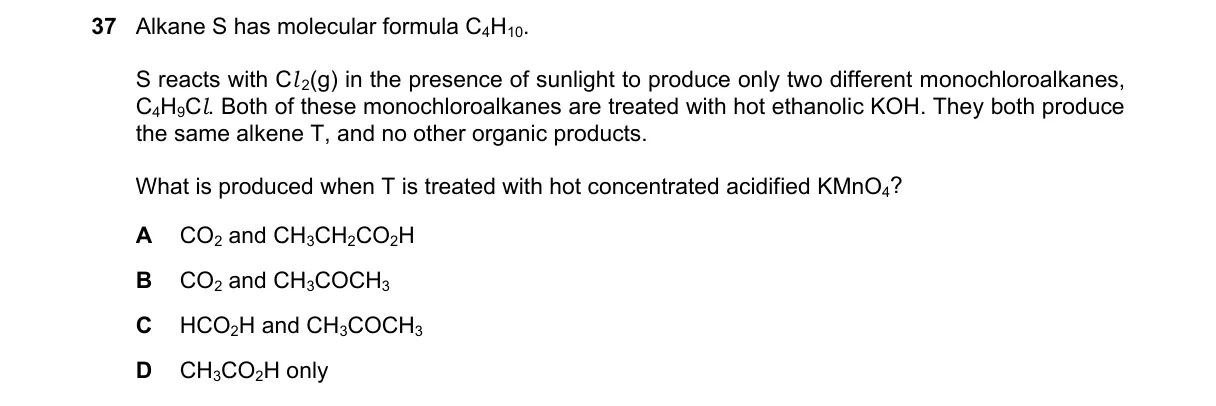
Answer choices
- ACO2 and CH3COOH
- BHCOOH and CH3COOH
- CCH3COOH only
- DCH3COOH only
Explanation
Propane yields propene, which cleaves to formic and acetic acids
Steps:
- Alkane C4H8 likely erroneous for C3H8 (propane); it has two nonequivalent hydrogens, yielding 1-chloropropane and 2-chloropropane via free radical chlorination.
- Ethanolic KOH dehydrohalogenates both to the same alkene T: propene (CH3CH=CH2).
- Hot concentrated dilute KMnO4 oxidatively cleaves propene's double bond.
- The =CH2 group forms HCOOH; the =CHCH3 group forms CH3COOH.
Why B is correct:
- Oxidative cleavage of terminal alkene CH3CH=CH2 yields CH3COOH from the substituted carbon and HCOOH from =CH2 under dilute conditions preventing further oxidation to CO2.
Why the others are wrong:
- A: =CH2 oxidizes to HCOOH (dilute KMnO4), not CO2 (vigorous conditions).
- C: Ignores HCOOH from =CH2; only CH3COOH would imply symmetrical internal alkene like but-2-ene.
- D: Same as C; duplicate option, incomplete products.
Final answer: B
Topic: Hydrocarbons
Practice more A Levels Chemistry (9701) questions on mMCQ.me