A Levels Chemistry (9701)•9701/12/M/J/25
A Levels Chemistry (9701) — 9701/12/M/J/25, Question 29
Ester, RCO2R', is hydrolysed in alkaline conditions. R and R' are different alkyl groups. Which row identifies the two products formed?
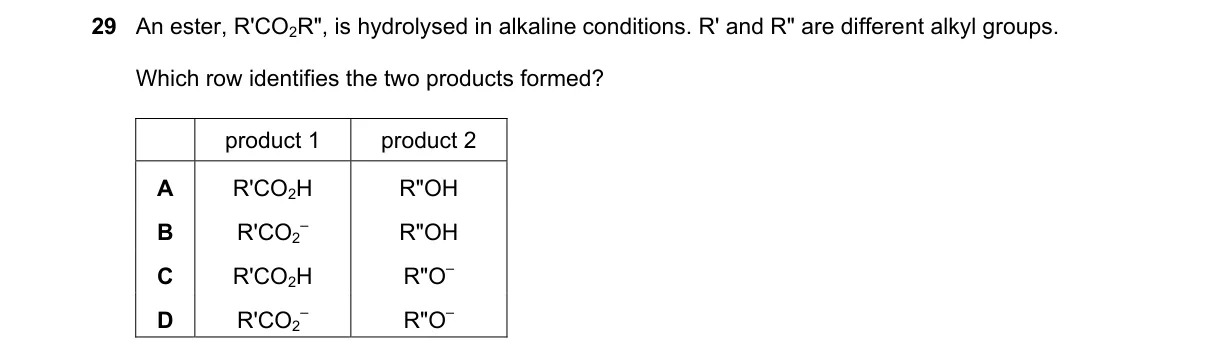
Answer choices
- ARCO2- R'OH
- BRCO2H R'OH
- CRCO2- R'O-
- DRCO2H R'O-
Explanation
Alkaline Hydrolysis of Esters Steps:
- Recognize alkaline hydrolysis (saponification) involves OH⁻ attacking the ester's carbonyl carbon.
- OH⁻ addition forms a tetrahedral intermediate.
- The intermediate collapses, expelling R'O⁻ and forming RCO₂⁻ after deprotonation.
- R'O⁻ abstracts H⁺ from water, yielding R'OH as the neutral alcohol product.
Why A is correct:
- The reaction RCO₂R' + OH⁻ → RCO₂⁻ + R'OH follows the mechanism where base deprotonates the initial carboxylic acid, producing the carboxylate ion and alcohol.
Why the others are wrong:
- B: RCO₂H forms in acidic hydrolysis, not alkaline, where base prevents protonation.
- C: R'O⁻ is transient and protonates to R'OH; two anions do not represent final neutral-basic products.
- D: RCO₂H and R'O⁻ mix acidic and basic outcomes, incorrect for alkaline conditions.
Final answer: A
Topic: Carboxylic acids and derivatives
Practice more A Levels Chemistry (9701) questions on mMCQ.me