A Levels Chemistry (9701)•9701/12/M/J/25
A Levels Chemistry (9701) — 9701/12/M/J/25, Question 22
Elements Y and Z are in Period 3. Element Y has the smallest atomic radius in Period 3. Elements Y and Z react together to form compound R which has a lower melting point than element Z. Which compound could be R?
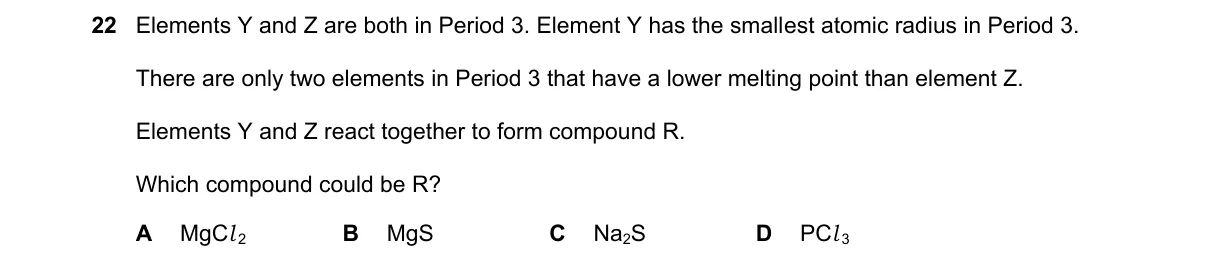
Answer choices
- AMgCl₂
- BMgS
- CNa₂S
- DPCl₃
Explanation
Y is Cl (smallest Period 3 radius); forms low-mp PCl₃ with Z=P.
Steps:
- Y=Cl due to smallest atomic radius in Period 3 (decreases left to right).
- Z=another Period 3 element; R=their compound with mp < Z's mp.
- Options must include Cl (Y) and Period 3 Z.
- Verify mp data: PCl₃ (-93°C) < P (44°C); others fail.
Why D is correct:
- PCl₃ forms from P (Z) and Cl (Y); covalent molecular structure yields low mp (-93°C) below P's (44°C) per intermolecular forces.
Why the others are wrong:
- A: MgCl₂ mp (714°C) > Mg mp (649°C); ionic lattice gives higher mp.
- B: No Cl, so Y cannot be Cl with smallest radius.
- C: No Cl, so Y cannot be Cl with smallest radius.
Final answer: D
Topic: The Periodic Table: chemical periodicity
Practice more A Levels Chemistry (9701) questions on mMCQ.me