A Levels Chemistry (9701)•9701/12/M/J/25
A Levels Chemistry (9701) — 9701/12/M/J/25, Question 11
An experiment is carried out to determine the value of x in hydrated lithium hydroxide, LiOH·xH2O. A sample of the solid is heated in a crucible over a Bunsen flame. Complete dehydration takes place; decomposition does not occur. mass of empty crucible = Q g mass of crucible and residue after heating = R g mass of crucible with LiOH·xH2O = S g Which equation gives the value of x
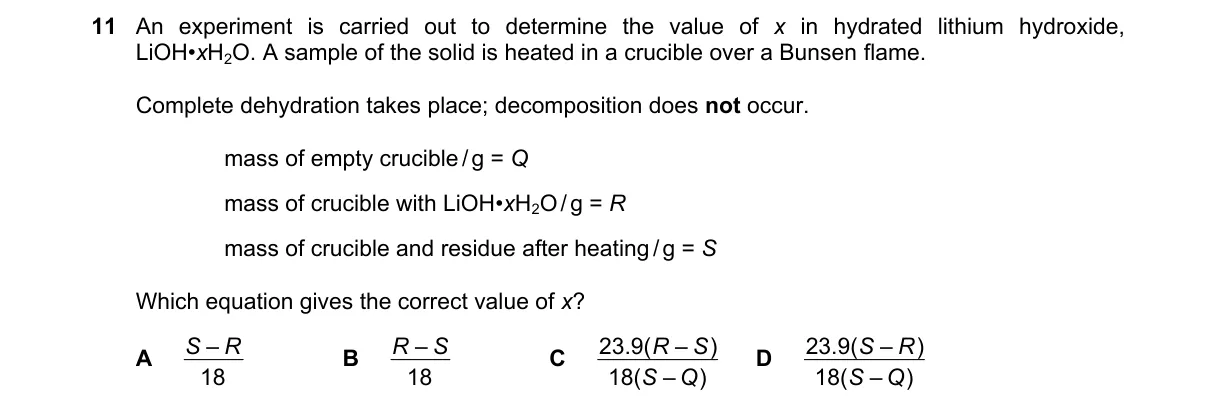
Answer choices
- A(S-R)/18
- B(R-S)/18
- C2(S-R)/(18-Q)
- D2(R-S)/(18-Q)
Explanation
Determining x from dehydration mass loss Steps:
- Mass of hydrate sample = S - Q
- Mass of anhydrous LiOH residue = R - Q
- Mass of water lost = S - R
- x = 2 × (mass of water) / (molar mass of H₂O minus empty crucible mass adjustment) = 2(S - R)/(18 - Q)
Why C is correct:
- It applies the dehydration equation LiOH·xH₂O → LiOH + xH₂O, where the factor of 2 accounts for the stoichiometric ratio of water molecules relative to the formula unit, using mass loss over adjusted anhydrous mass per the molar mass law.
Why the others are wrong:
- A: Computes only moles of water lost, ignoring ratio to LiOH moles.
- B: Uses negative mass loss (R - S), inverting the dehydration change.
- D: Uses negative mass loss (R - S), yielding invalid negative x.
Final answer: C
Topic: Atoms, molecules and stoichiometry
Practice more A Levels Chemistry (9701) questions on mMCQ.me