A Levels Chemistry (9701)•9701/11/M/J/25
A Levels Chemistry (9701) — 9701/11/M/J/25, Question 33
A possible mechanism for the exothermic hydrolysis of 2-chloro-2-methylpropane is shown. CH3-C(CH3)2Cl (slow) CH3-C+(CH3)2 + Cl- CH3-C+(CH3)2 + OH- (fast) CH3-C(OH)(CH3)2 Which diagram represents the reaction pathway diagram for this mechanism?
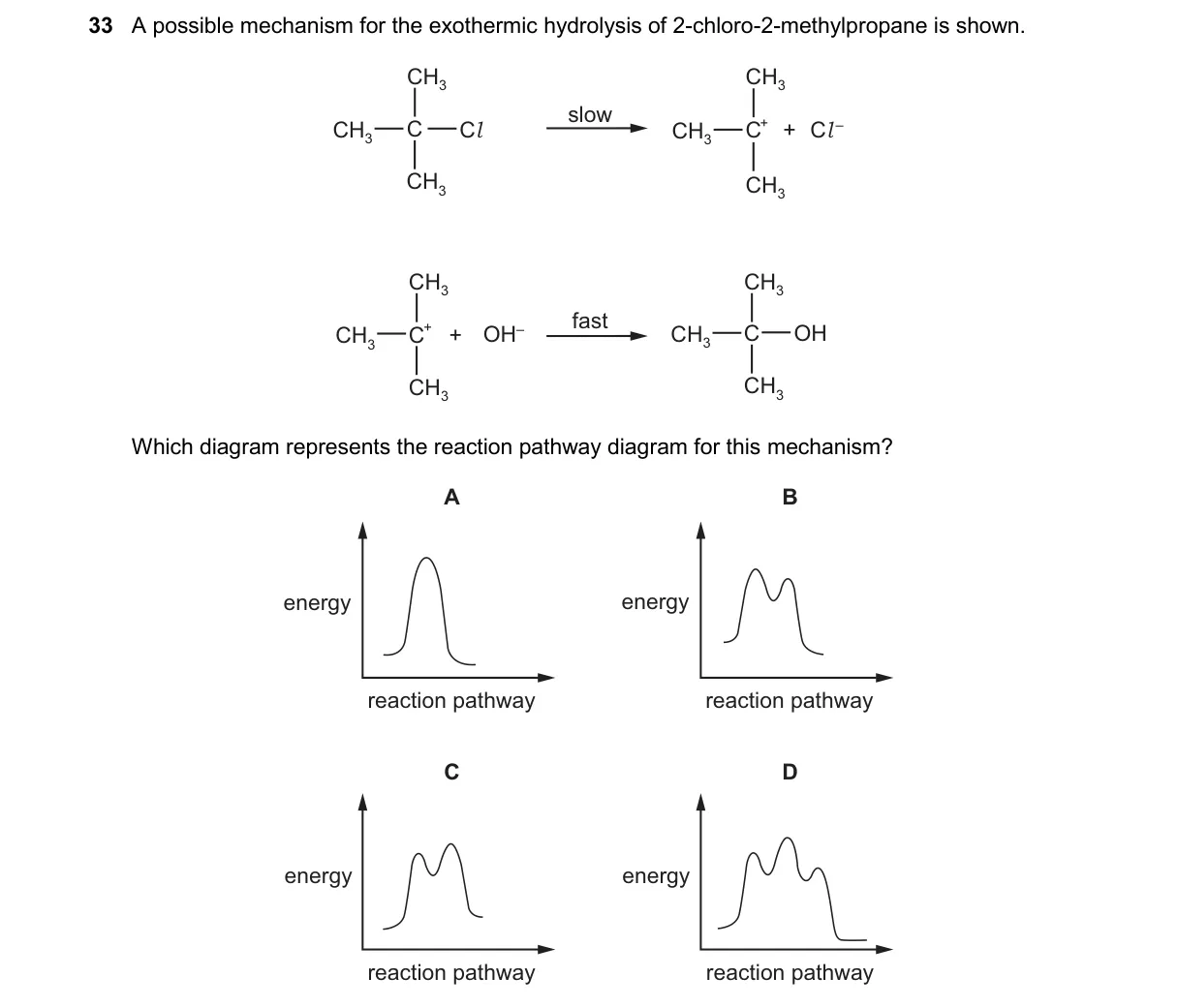
Answer choices
- AOption A
- BOption B
- COption C
- DOption D
Explanation
SN1 Mechanism Energy Profile Steps:
- Recognize the mechanism as SN1: slow unimolecular dissociation to carbocation intermediate, followed by fast nucleophilic attack.
- Sketch energy diagram: reactants high, large Ea for slow step to high-energy carbocation intermediate, small Ea for fast step to lower-energy products (exothermic overall).
- Look for diagram showing single deep intermediate valley after first high barrier, then shallow drop to products below reactants.
- Match to options: select diagram with these features.
Why B is correct:
- B depicts a high-energy intermediate after a tall first barrier and a short second barrier leading to exothermic products, matching the slow-fast SN1 steps per transition state theory.
Why the others are wrong:
- A: Shows concerted single step with no intermediate, unlike two-step mechanism.
- C: Symmetric barriers indicate equal rates, not slow first step.
- D: Endothermic profile with products above reactants, contradicting exothermic hydrolysis.
Final answer: B
Topic: Halogen compounds
Practice more A Levels Chemistry (9701) questions on mMCQ.me