A Levels Chemistry (9701)•9701/11/M/J/25
A Levels Chemistry (9701) — 9701/11/M/J/25, Question 26
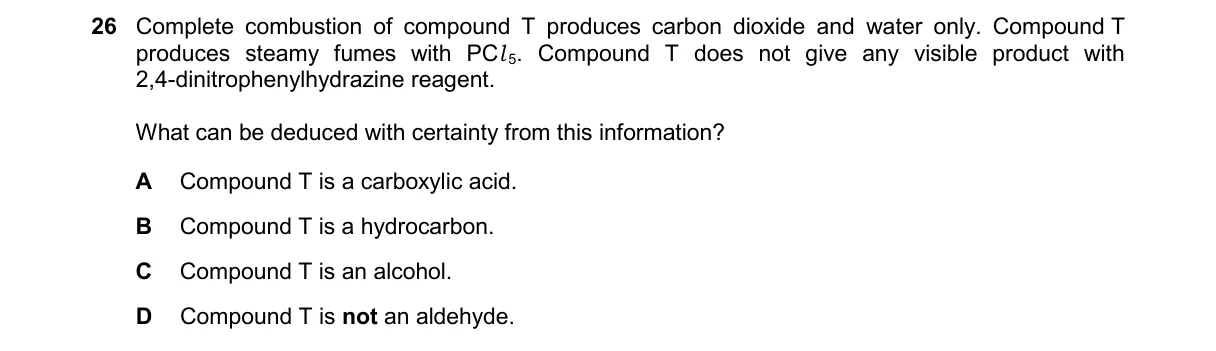
Complete combustion of compound T produces carbon dioxide and water only. Compound T produces steamy fumes with PCl5. Compound T does not give any visible product with 2,4-dinitrophenylhydrazine. What can be deduced with certainty from this information?
Answer choices
- ACompound T is a carboxylic acid.
- BCompound T is a hydrocarbon.
- CCompound T is an alcohol.
- DCompound T is an aldehyde.
Explanation
Functional group identification via chemical tests Steps:
- Complete combustion to CO2 and H2O indicates T contains C, H, and possibly O, but no N, S, or halogens.
- Steamy fumes with PCl5 confirm presence of -OH group (alcohols or carboxylic acids react to form HCl).
- No visible product with 2,4-DNPH rules out aldehydes and ketones (test specific for those carbonyls).
- Carboxylic acids have -COOH (includes -OH) but their carbonyl does not react with 2,4-DNPH, so both alcohols and carboxylic acids fit all tests.
Why D is correct:
- Not applicable; tests contradict aldehyde (would react with 2,4-DNPH).
Why the others are wrong:
- A: Possible but not certain (could be alcohol instead).
- B: No -OH, so no PCl5 reaction.
- C: Possible but not certain (could be carboxylic acid instead).
Not enough information. Final answer: Not enough information.
Topic: Hydroxy compounds
Practice more A Levels Chemistry (9701) questions on mMCQ.me