A Levels Chemistry (9701)•9701/11/M/J/25
A Levels Chemistry (9701) — 9701/11/M/J/25, Question 23
Each mineral listed behaves as a mixture of two carbonate compounds. They can be used as fire retardants because they decompose to produce CO₂. This smothers the fire. baryte BaCO₃ dolomite CaMg(CO₃)₂ huntite CaMg₃(CO₃)₄ What is the order of effectiveness as fire retardants, from best to worst? best → worst
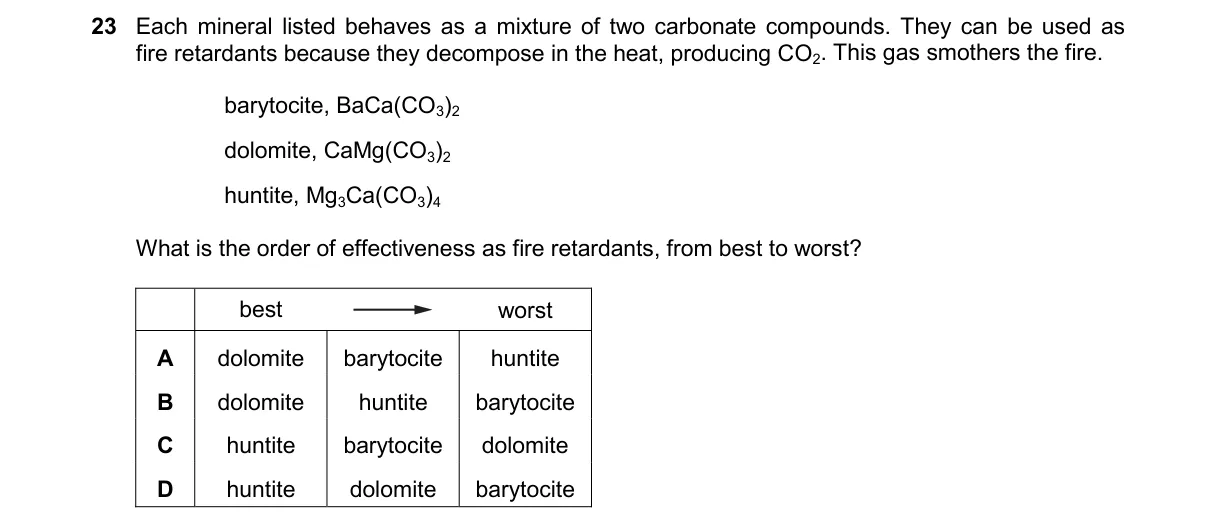
Answer choices
- Adolomite huntite huntite
- Bhuntite dolomite huntite
- Chuntite dolomite dolomite
- Dhuntite dolomite baryte
Explanation
Effectiveness depends on CO₂ yield per unit mass Steps:
- Calculate molar mass and CO₂ mass for each mineral's decomposition.
- Baryte (BaCO₃): 197 g/mol, yields 44 g CO₂ (fraction 0.223).
- Dolomite (CaMg(CO₃)₂): 184 g/mol, yields 88 g CO₂ (fraction 0.478).
- Huntite (CaMg₃(CO₃)₄): 352 g/mol, yields 176 g CO₂ (fraction 0.5).
- Order by descending CO₂ fraction: huntite > dolomite > baryte.
Why D is correct:
- Huntite releases the most CO₂ per gram (50%), followed by dolomite (47.8%) and baryte (22.3%), maximizing fire-smothering per mass.
Why the others are wrong:
- A: Repeats huntite incorrectly and omits baryte.
- B: Repeats huntite and ignores baryte.
- C: Repeats dolomite and excludes baryte.
Final answer: D
Topic: Group 2
Practice more A Levels Chemistry (9701) questions on mMCQ.me