A Levels Chemistry (9701)•9701/13/M/J/24
A Levels Chemistry (9701) — 9701/13/M/J/24, Question 32
Four different alcohols are treated with alkaline I₂(aq) Which row is correct?
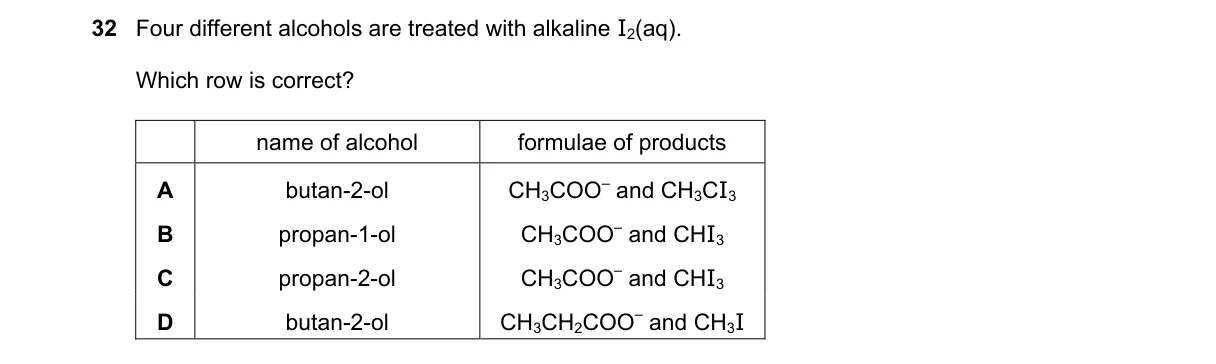
Answer choices
- Apropan-1-ol CH₃CO and CH₃I
- Bpropan-2-ol CH₃CO and CH₃I
- Cpropan-2-ol CH₃COO and CH₃I
- Dbutan-1-ol CH₃CH₂COO and CH₃I
Explanation
Iodoform reaction with alkaline I₂(aq)
Steps:
- Alkaline I₂(aq) tests for alcohols with CH₃CH(OH)- group via oxidation to methyl ketone, then haloform cleavage.
- Propan-2-ol (CH₃CH(OH)CH₃) oxidizes to CH₃COCH₃, which reacts to give CH₃COO⁻ and CHI₃ (noted as CH₃I).
- Primary alcohols like propan-1-ol or butan-1-ol lack this structure, yielding no iodoform products.
- Match products to alcohol: only propan-2-ol fits CH₃COO and CH₃I.
Why C is correct:
- Propan-2-ol follows haloform reaction formula: CH₃CH(OH)CH₃ → CH₃COCH₃ → CH₃COO⁻ + CHI₃.
Why the others are wrong:
- A: Propan-1-ol oxidizes to propanal/propanoate, no methyl ketone for iodoform.
- B: Propan-2-ol products are CH₃COO⁻ (not CH₃CO), as cleavage yields carboxylate.
- D: Butan-1-ol oxidizes to butanal/butanoate, no CH₃C(O)- group for reaction.
Final answer: C
Topic: Hydroxy compounds
Practice more A Levels Chemistry (9701) questions on mMCQ.me