A Levels Chemistry (9701)•9701/13/M/J/24
A Levels Chemistry (9701) — 9701/13/M/J/24, Question 28
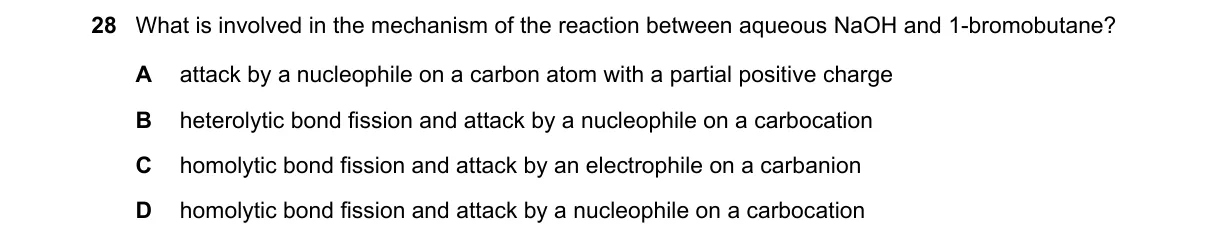
What is involved in the mechanism of the reaction between aqueous NaOH and 1-bromobutane?
Answer choices
- Aheterolytic bond fission and attack by a nucleophile on a carbon atom with partial positive charge
- Bheterolytic bond fission and attack by a nucleophile on a carbocation
- Chomolytic bond fission and attack by an electrophile on a carbocation
- Dhomolytic bond fission and attack by a nucleophile on a carbocation
Explanation
SN2 Mechanism for Primary Alkyl Halide Substitution
Steps:
- Identify the reaction as nucleophilic substitution between OH⁻ (nucleophile) and 1-bromobutane (primary alkyl halide).
- Recall that primary alkyl halides undergo SN2 mechanism in aqueous NaOH, not SN1.
- In SN2, the C-Br bond undergoes heterolytic fission (electrons move to Br⁻).
- The nucleophile (OH⁻) attacks the carbon in a concerted step, forming a transition state with partial positive charge on carbon.
Why A is correct:
- SN2 involves heterolytic bond fission where the nucleophile attacks the carbon with partial positive charge in the transition state, as defined by the concerted backside displacement mechanism.
Why the others are wrong:
- B: Describes SN1, which forms a full carbocation intermediate, not suitable for primary halides.
- C: Homolytic fission implies radical mechanism; electrophiles attack electron-rich sites, not carbocations.
- D: Homolytic fission is for free radical reactions, not nucleophilic substitution on carbocations.
Final answer: A
Topic: Halogen compounds
Practice more A Levels Chemistry (9701) questions on mMCQ.me