A Levels Chemistry (9701)•9701/11/M/J/24
A Levels Chemistry (9701) — 9701/11/M/J/24, Question 39
A section showing two repeat units of an addition polymer is shown. What is the identity of the monomer that produced this polymer?
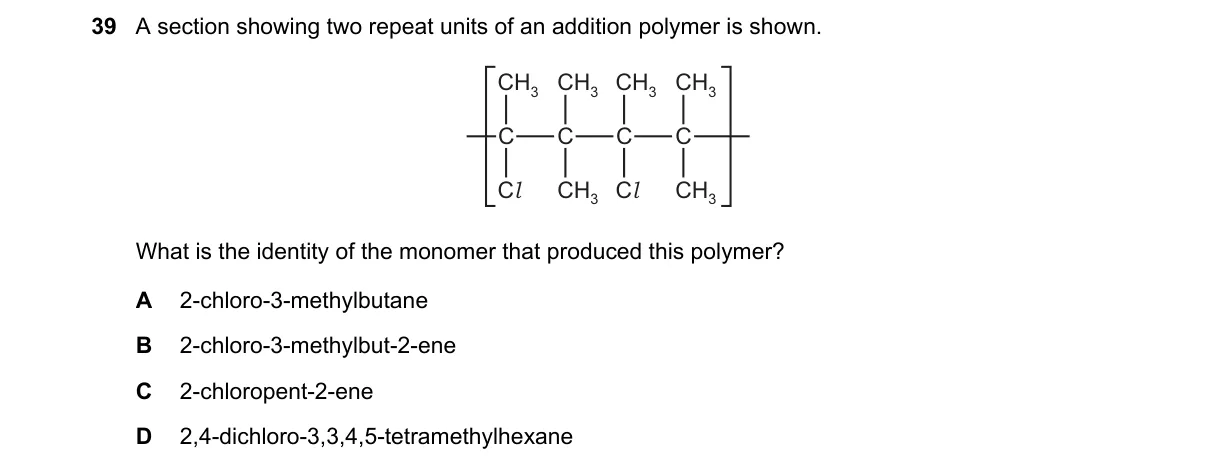
Answer choices
- A2-chloro-3-methylbutane
- B2-chloro-3-methylbut-2-ene
- C2-chloropent-3-yne
- D2,4-dichloro-3,5-tetramethylhexane
Explanation
Identify monomer by reversing addition polymerization
Steps:
- Examine the repeat unit structure in the polymer section to identify the carbon chain and substituents.
- Locate the connection between repeat units, which formed by breaking the monomer's double bond.
- Reconstruct the monomer by adding a double bond between the carbons that linked during polymerization.
- Match the resulting structure to the given options, confirming the chloro and methyl positions.
Why B is correct:
- 2-Chloro-3-methylbut-2-ene is an alkene that undergoes addition polymerization, opening the C=C bond to form the observed repeat unit with chlorine intact.
Why the others are wrong:
- A: Alkane lacks a double bond, cannot form addition polymer.
- C: Alkyne would produce a different repeat unit via triple bond addition, not matching the structure.
- D: Dihaloalkane suggests substitution polymerization, not addition, and has extra chlorines.
Final answer: B
Topic: Polymerisation
Practice more A Levels Chemistry (9701) questions on mMCQ.me