A Levels Chemistry (9701)•9701/11/M/J/24
A Levels Chemistry (9701) — 9701/11/M/J/24, Question 30
Q is either a primary or a tertiary haloalkane. Q undergoes hydrolysis with aqueous sodium hydroxide. The first step in the mechanism of this reaction involves two species reacting together. Which row is correct?
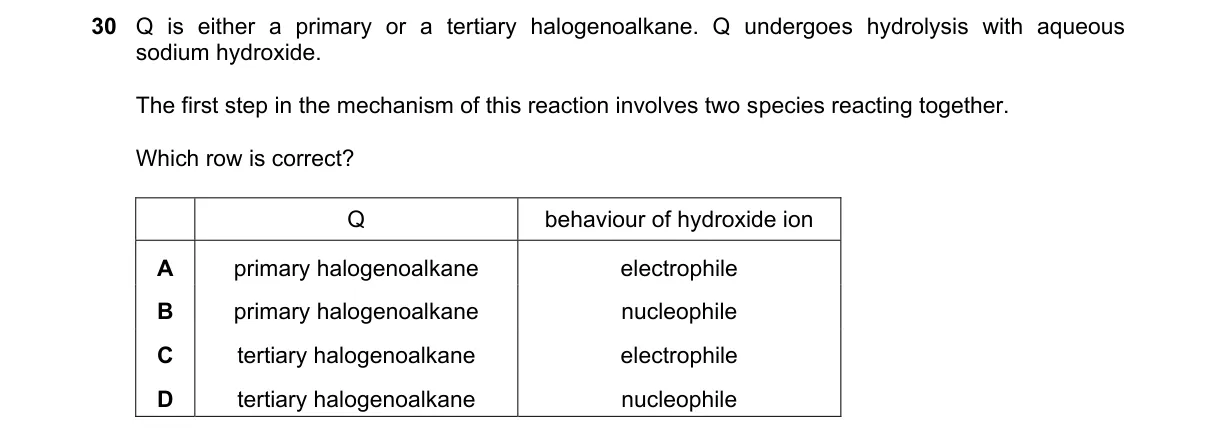
Answer choices
- Aprimary haloalkane, electrophile
- Bprimary haloalkane, nucleophile
- Ctertiary haloalkane, nucleophile
- Dtertiary haloalkane, electrophile
Explanation
SN2 mechanism for primary haloalkane hydrolysis
Steps:
- Hydrolysis of haloalkanes with aqueous NaOH is nucleophilic substitution.
- Primary haloalkanes follow SN2 mechanism, bimolecular in the rate-determining step.
- First step of SN2: OH⁻ nucleophile attacks the electrophilic carbon of the haloalkane.
- Two species react together: the primary haloalkane and the nucleophile OH⁻.
- Tertiary haloalkanes follow SN1, with unimolecular first step (C–X bond breaks alone).
Why B is correct:
- B specifies primary haloalkane, where the first step involves reaction with a nucleophile (OH⁻), as defined in the SN2 mechanism.
Why the others are wrong:
- A: For primary, the other reacting species is nucleophile OH⁻, not electrophile.
- C: Tertiary haloalkane uses SN1; first step is unimolecular, no second species reacts.
- D: Tertiary haloalkane's SN1 first step involves only one species, not two reacting together.
Final answer: B
Topic: Halogen compounds
Practice more A Levels Chemistry (9701) questions on mMCQ.me