A Levels Chemistry (9701)•9701/13/M/J/23
A Levels Chemistry (9701) — 9701/13/M/J/23, Question 36
Compound Q can be hydrolysed by HCl(aq). The products of this hydrolysis have the same empirical formula. What could be Q.
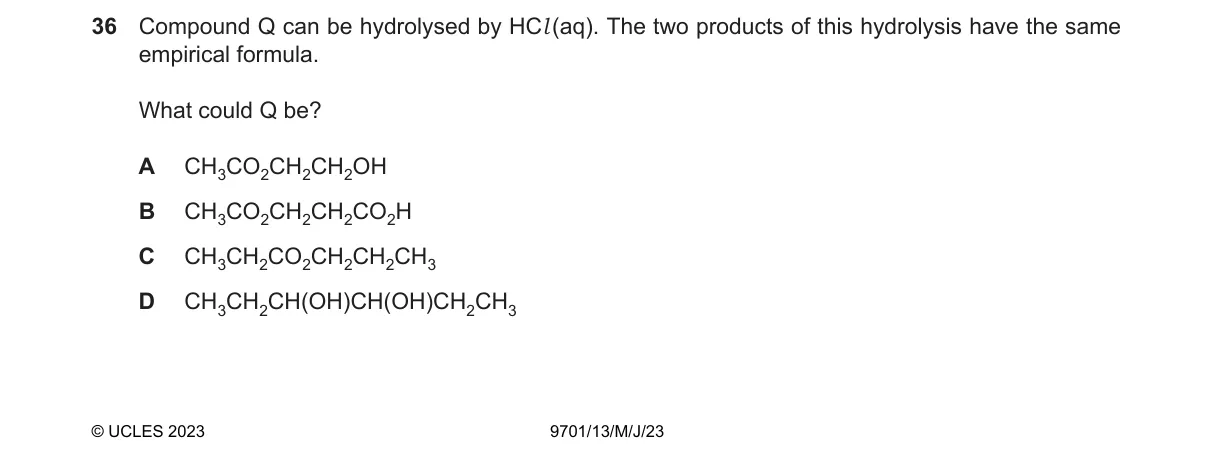
Answer choices
- ACH3COCH2OH
- BCH3COCH2COCH3
- CCH3CH2OCH2CH3
- DCH3CH2OCH2CH2OCH2CH3
Explanation
Acid hydrolysis of symmetrical β-diketone to identical carboxylic acids
Steps:
- Identify compounds susceptible to acid hydrolysis: ethers and β-diketones can react, but check product empirical formulas.
- For B (CH3COCH2COCH3), recognize as symmetrical 1,3-diketone with empirical formula C5H8O2.
- Hydrolysis cleaves central C-C bond: CH3COCH2COCH3 + H2O → 2 CH3COOH.
- Both products have identical empirical formula C2H4O2, matching the condition.
Why B is correct:
- Symmetrical β-diketones undergo acid-catalyzed hydrolysis (reverse of Claisen condensation) to yield two molecules of the same carboxylic acid, here acetic acid (C2H4O2).
Why the others are wrong:
- A: α-Hydroxy ketone lacks cleavable bond for hydrolysis; no products with matching empirical formulas.
- C: Ether cleavage by HCl gives C2H5Cl (C2H5Cl) and C2H5OH (C2H6O), different empirical formulas.
- D: Diether hydrolysis yields mixed alcohols and halides like C2H5OH (C2H6O) and HOCH2CH2OH (C2H6O2), not identical.
Final answer: B
Topic: Hydroxy compounds
Practice more A Levels Chemistry (9701) questions on mMCQ.me