A Levels Chemistry (9701)•9701/13/M/J/23
A Levels Chemistry (9701) — 9701/13/M/J/23, Question 25
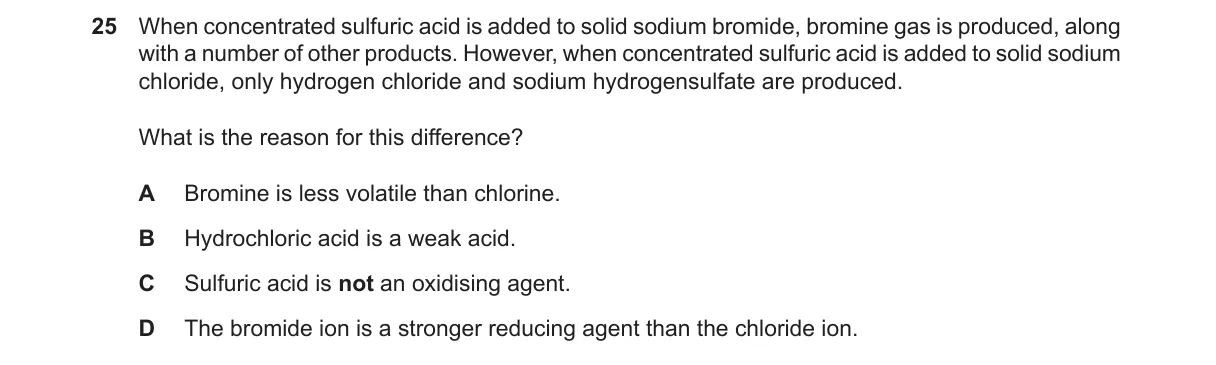
When concentrated sulfuric acid is added to solid sodium bromide, bromine is produced, along with a number of other products. However, when concentrated sulfuric acid is added to solid sodium chloride, only hydrogen chloride and sodium hydrogensulfate are produced. What is the reason for this difference?
Answer choices
- ABromine is less volatile than chlorine.
- BHydrochloric acid is a weak acid.
- CSulfuric acid is not an oxidizing agent.
- DThe bromide ion is a stronger reducing agent than the chloride ion.
Explanation
Reducing Strength of Halide Ions
Steps:
- Concentrated H₂SO₄ reacts with NaBr to form HBr, which reduces H₂SO₄ to produce Br₂.
- With NaCl, H₂SO₄ forms HCl, but HCl does not reduce H₂SO₄ further.
- Br⁻ ions reduce sulfate to SO₂ and themselves oxidize to Br₂, per the reaction: 2Br⁻ + H₂SO₄ → Br₂ + SO₂ + H₂O.
- Cl⁻ lacks sufficient reducing power to oxidize by H₂SO₄, so only HCl forms.
Why D is correct:
- Br⁻ is a stronger reducing agent than Cl⁻ because bromide has lower electronegativity and easier loss of electrons, as per standard reduction potentials (E° Br₂/Br⁻ = +1.07 V vs. E° Cl₂/Cl⁻ = +1.36 V).
Why the others are wrong:
- A: Volatility affects distillation, not the redox reaction producing Br₂.
- B: HCl is a strong acid, not weak; acidity strength is irrelevant here.
- C: H₂SO₄ acts as a mild oxidizing agent toward Br⁻ but not Cl⁻.
Final answer: D
Topic: Group 17
Practice more A Levels Chemistry (9701) questions on mMCQ.me