A Levels Chemistry (9701)•9701/13/M/J/23
A Levels Chemistry (9701) — 9701/13/M/J/23, Question 15
Sulfur dioxide reacts with oxygen as shown. 2SO2(g) + O2(g) ⇌ 2SO3(g) ΔH = -197 kJ/mol Which change will shift the equilibrium position to the right side and change the value of the equilibrium constant K?
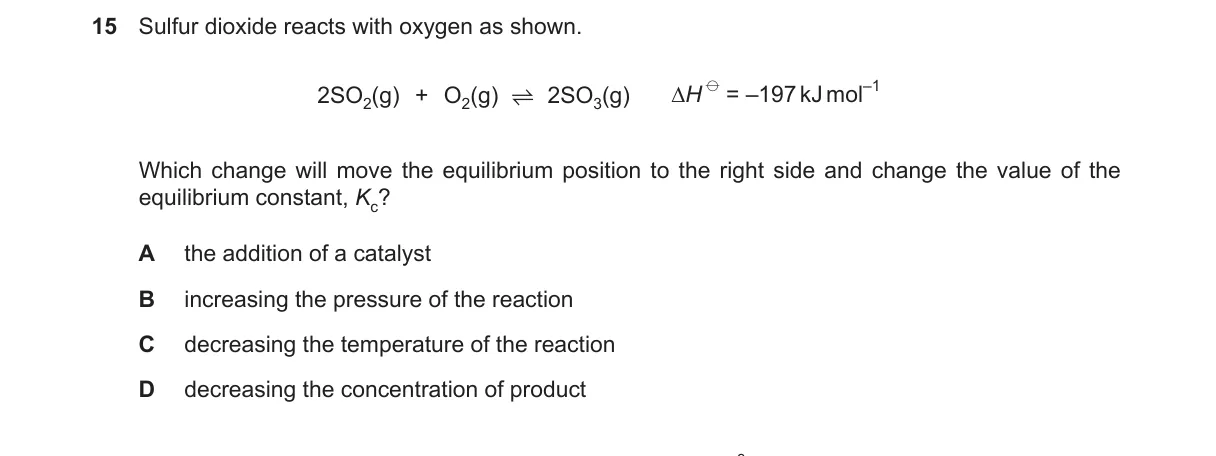
Answer choices
- Aincreasing the pressure of the reaction
- Bthe addition of a catalyst
- Cdecreasing the temperature of the reaction
- Ddecreasing the concentration of product
Explanation
Le Chatelier's Principle for Exothermic Equilibrium
Steps:
- Reaction is exothermic (ΔH < 0), so heat acts as product; decreasing temperature favors forward reaction to produce heat.
- Equilibrium shifts right for exothermic reactions when temperature decreases, increasing K since K = [SO3]^2 / ([SO2]^2 [O2]) and lower T boosts product concentrations.
- Pressure affects position based on moles (4 to 3, shifts right) but not K value.
- Catalysts and concentration changes alter rates or position without changing K.
Why C is correct:
- For exothermic reactions, decreasing temperature shifts equilibrium right (Le Chatelier's principle) and increases K, as van't Hoff equation shows ln K = -ΔH/RT + constant.
Why the others are wrong:
- A: Increases pressure shifts right (fewer gas moles) but K remains unchanged.
- B: Catalyst equilibrates faster with no position shift or K change.
- D: Decreases [SO3], shifting left to restore product, not right.
Final answer: C
Topic: Equilibria
Practice more A Levels Chemistry (9701) questions on mMCQ.me