A Levels Chemistry (9701)•9701/13/M/J/23
A Levels Chemistry (9701) — 9701/13/M/J/23, Question 13
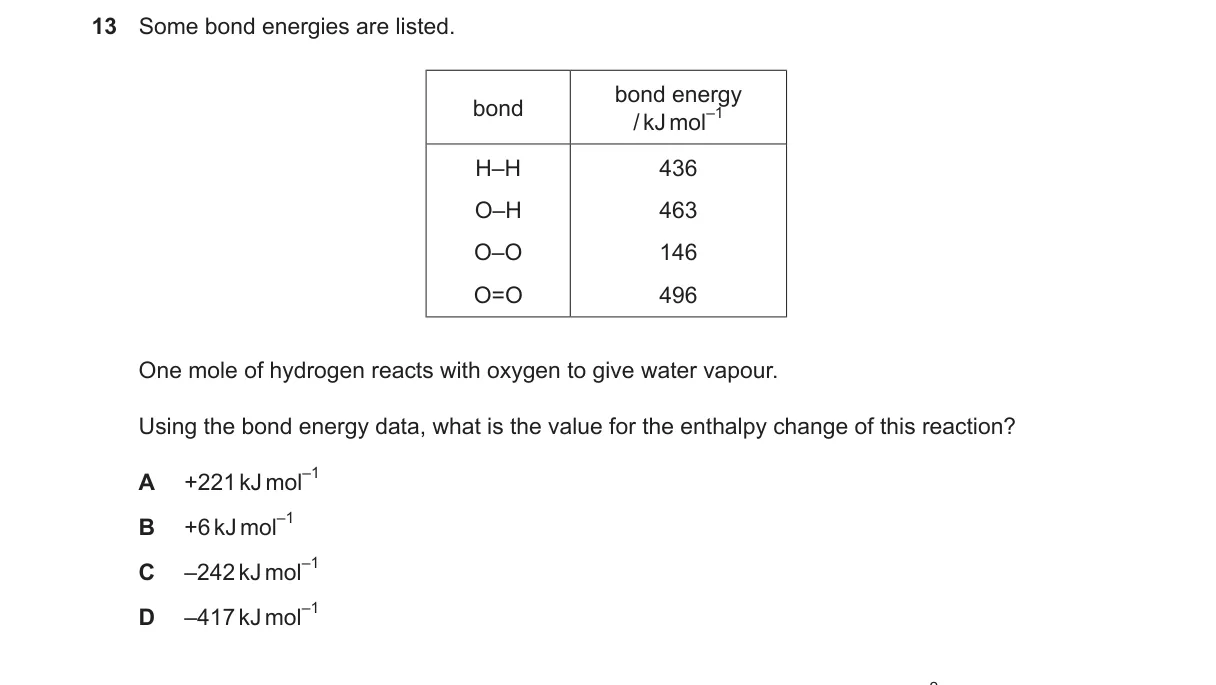
One mole of hydrogen reacts with oxygen to give water vapour. Using the bond energy data, what is the value for the enthalpy change of this reaction?
Answer choices
- A+221 kJ mol^{-1}
- B+436 kJ mol^{-1}
- C-242 kJ mol^{-1}
- D-436 kJ mol^{-1}
Explanation
Enthalpy Change via Bond Energies for H₂ + ½O₂ → H₂O(g)
Steps:
- Identify bonds broken: one H–H (436 kJ/mol) and half O=O (½ × 496 = 248 kJ/mol); total energy input = 684 kJ/mol.
- Identify bonds formed: two O–H (2 × 463 = 926 kJ/mol); total energy released = 926 kJ/mol.
- Calculate ΔH = energy to break bonds – energy from forming bonds = 684 – 926 = –242 kJ/mol.
- Confirm for one mole of H₂ reacting to form one mole of H₂O vapor.
Why C is correct:
- Matches the formula ΔH = Σ(bond energies broken) – Σ(bond energies formed), yielding exothermic –242 kJ/mol for water vapor formation.
Why the others are wrong:
- A: Positive value ignores exothermic nature; likely misapplies sign for endothermic.
- B: Equals H–H bond energy alone, omitting O=O and O–H contributions.
- D: Negative H–H energy alone, ignoring full reaction bonds.
Final answer: C
Topic: Chemical energetics
Practice more A Levels Chemistry (9701) questions on mMCQ.me