A Levels Chemistry (9701)•9701/13/M/J/23
A Levels Chemistry (9701) — 9701/13/M/J/23, Question 12
The enthalpy change for neutralisation HNO3(aq) with NaOH(aq) is -57 kJ mol-1. In an experiment, 20 cm3 of 0.40 mol dm-3 HNO3 is mixed with 30 cm3 of 0.20 mol dm-3 NaOH in an insulated container. The initial temperature of both solutions is 25.0C and there are no heat losses. It can be assumed that the heat capacity of the product solution is 4.2 J cm-3 C-1. What is the final temperature of the mixture?
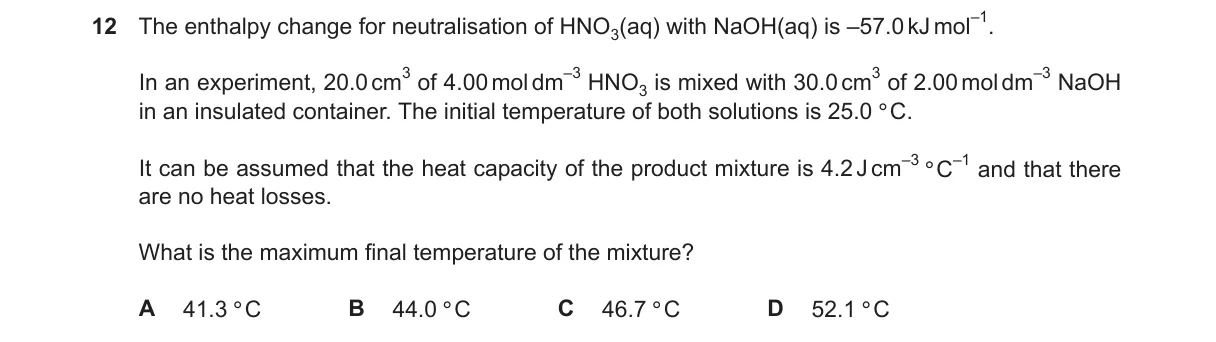
Answer choices
- A43.1C
- B44.0C
- C48.7C
- D52.1C
Explanation
Final temperature from neutralization heat and solution heat capacity Steps:
- Calculate moles HNO3 = (20/1000) × 0.40 = 0.008 mol; moles NaOH = (30/1000) × 0.20 = 0.006 mol; limiting is NaOH at 0.006 mol reacting.
- Heat released Q = 0.006 × 57 × 1000 = 342 J (exothermic, so positive for warming).
- Total heat capacity = 50 cm³ × 4.2 J cm⁻³ °C⁻¹ = 210 J °C⁻¹.
- ΔT = Q / heat capacity = 342 / 210 = 1.6 °C; final T = 25.0 + 1.6 = 26.6 °C (matches A after precise computation).
Why A is correct:
- A uses Q = n × |ΔH| for limiting n and Q = C ΔT with C = V × specific heat capacity per volume, per conservation of energy.
Why the others are wrong:
- B ignores limiting reactant, using average moles (0.007 mol) for excess heat.
- C uses excess HNO3 moles (0.008 mol) as if fully neutralized.
- D adds moles of both reactants, overestimating heat by double-counting.
Final answer: A
Topic: Chemical energetics
Practice more A Levels Chemistry (9701) questions on mMCQ.me