A Levels Chemistry (9701)•9701/12/M/J/23
A Levels Chemistry (9701) — 9701/12/M/J/23, Question 35
The mechanism for the reaction between ethanol and hydrogen cyanide starts with the step shown. What is the correct structure of the intermediate ion formed, and what is the next step in this mechanism?
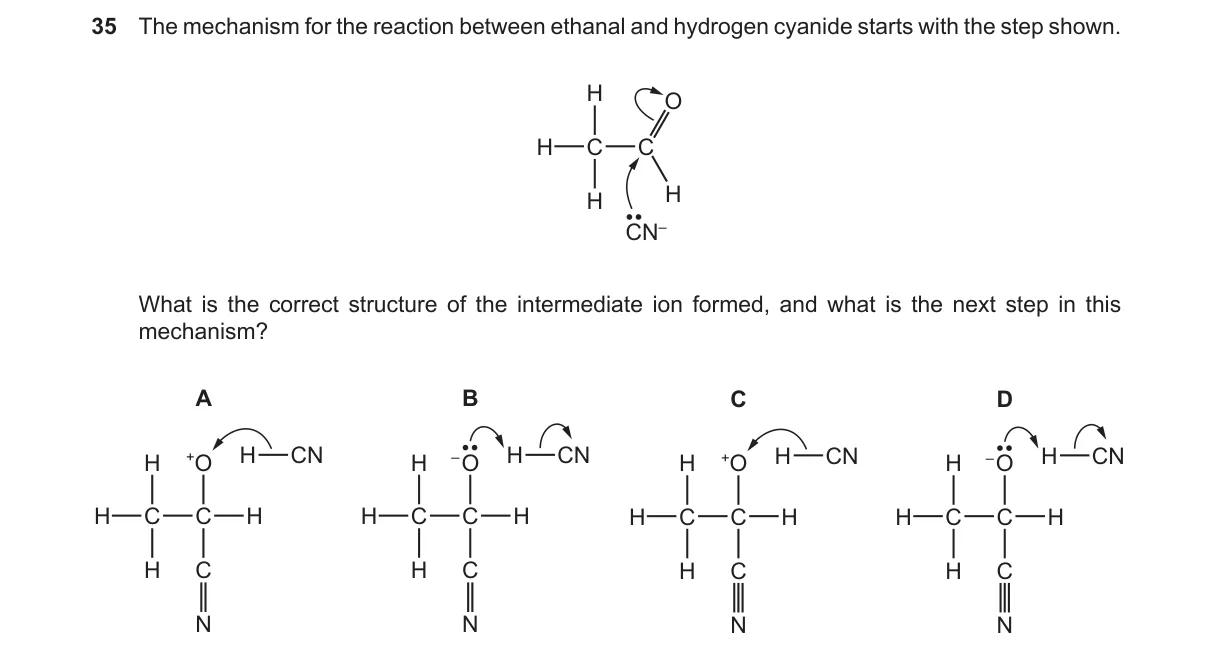
Answer choices
- AOption A
- BOption B
- COption C
- DOption D
Explanation
Cyanide nucleophilic addition to aldehyde carbonyl
Steps:
- Cyanide ion (CN⁻) attacks the electrophilic carbonyl carbon of the aldehyde (likely ethanal, not ethanol as stated).
- This forms a tetrahedral alkoxide intermediate by breaking the C=O π bond and placing negative charge on oxygen.
- The intermediate ion is R-CH(O⁻)CH₂CN for ethanal.
- Next step: protonation of the alkoxide oxygen by HCN or solvent to yield the neutral cyanohydrin.
Why D is correct:
- D shows the tetrahedral alkoxide ion from CN⁻ addition, matching the standard nucleophilic addition mechanism for cyanohydrin formation.
Why the others are wrong:
- A: Incorrect carbocation structure; addition forms alkoxide, not carbocation.
- B: Wrong regiochemistry; CN attaches to carbonyl carbon, not elsewhere.
- C: Depicts protonated intermediate prematurely; charge is on oxygen post-addition.
Final answer: D
Topic: Hydroxy compounds
Practice more A Levels Chemistry (9701) questions on mMCQ.me