A Levels Chemistry (9701)•9701/12/M/J/23
A Levels Chemistry (9701) — 9701/12/M/J/23, Question 32
Halogenoalkanes react with hot ethanolic potassium cyanide. The reaction mechanism is either SN1 or SN2.
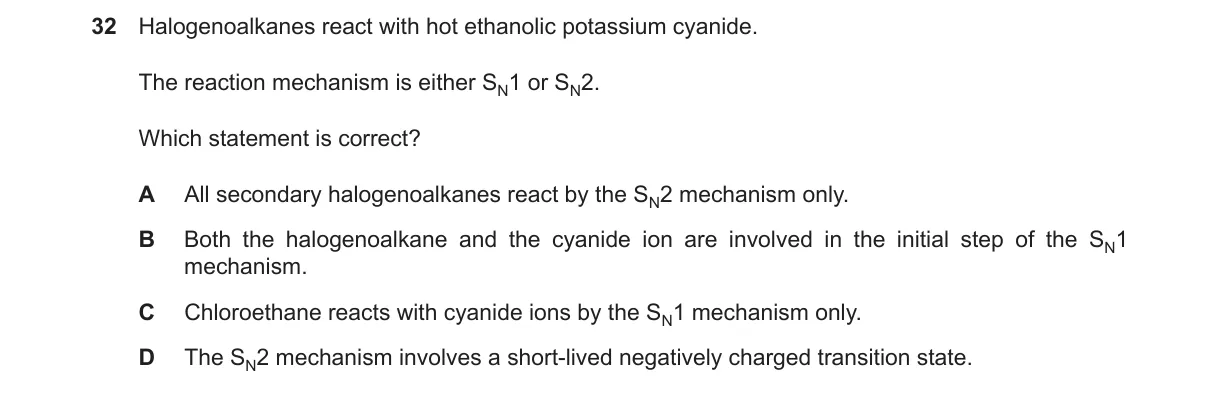
Answer choices
- AAll secondary halogenoalkanes react by the SN2 mechanism only.
- BBoth the halogenoalkane and the cyanide ion are involved in the initial step of the SN1
- CChloroethane reacts with cyanide ions by the SN1 mechanism only.
- DThe SN2 mechanism involves a short-lived negatively charged transition state.
Explanation
SN1 vs SN2 mechanisms in nucleophilic substitution
Steps:
- SN2 is a concerted bimolecular process with a single transition state involving the nucleophile and substrate.
- SN1 is a two-step unimolecular process starting with slow formation of a carbocation intermediate.
- Evaluate options: A claims secondary always SN2 (false, can be both); B misstates SN1 initial step (not bimolecular); C assigns SN1 to primary chloroethane (incorrect, primaries favor SN2); D describes SN2 transition state accurately.
- Select D as it matches SN2 definition.
Why D is correct:
- In SN2, the transition state is a pentacoordinate species with partial bonds to both the incoming cyanide nucleophile (CN⁻) and departing halide, resulting in a short-lived negative charge.
Why the others are wrong:
- A: Secondary halogenoalkanes can react via both SN1 and SN2, depending on solvent and conditions.
- B: SN1 initial step is unimolecular, involving only the halogenoalkane dissociating to form a carbocation; cyanide acts later.
- C: Primary halogenoalkanes like chloroethane favor SN2 due to low steric hindrance and no stable carbocation.
Final answer: D
Topic: Halogen compounds
Practice more A Levels Chemistry (9701) questions on mMCQ.me