A Levels Chemistry (9701)•9701/12/M/J/23
A Levels Chemistry (9701) — 9701/12/M/J/23, Question 24
The equation shows a reaction that occurs between carbon monoxide and nitrogen monoxide in a catalytic converter. 2CO(g) + 2NO(g) → 2CO₂(g) + N₂(g) Which statement is correct?
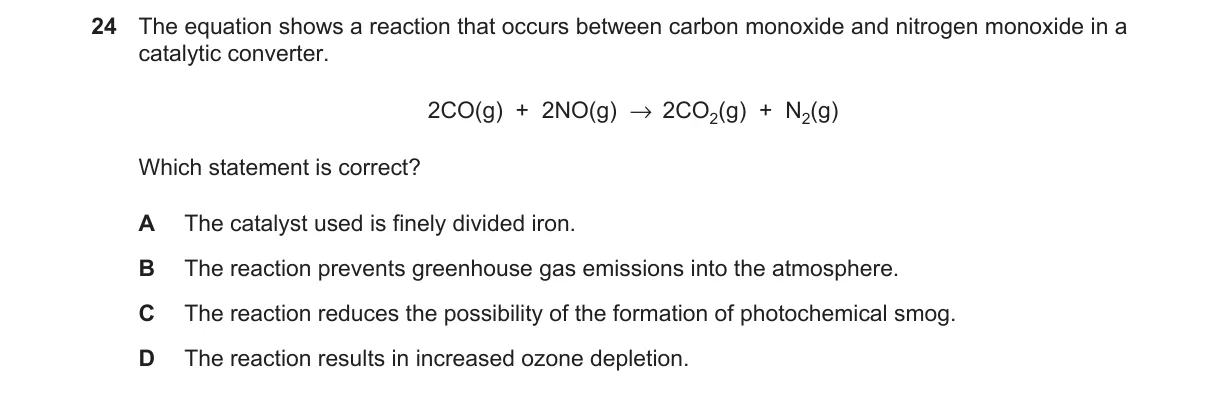
Answer choices
- AThe catalyst used finely divided iron.
- BThe reaction prevents greenhouse gas emissions into the atmosphere.
- CThe reaction reduces the possibility of formation of photochemical smog.
- DThe reaction results in increased ozone depletion.
Explanation
Reducing NOx Emissions in Catalytic Converters
Steps:
- Identify reactants: CO and NO are exhaust pollutants from combustion.
- Note products: CO2 and N2 are less harmful and non-reactive.
- Recall photochemical smog: Forms via NO reacting with VOCs and sunlight to create ozone and haze.
- Link reaction: Converts NO to N2, lowering NOx levels that trigger smog.
Why C is correct:
- NO is a key precursor in photochemical smog formation; reducing it via the reaction decreases ground-level ozone and particulate production, per air quality chemistry.
Why the others are wrong:
- A: Catalytic converters use platinum-group metals like platinum and rhodium, not iron.
- B: Converts CO to CO2, a greenhouse gas, so it does not prevent emissions.
- D: Products CO2 and N2 do not contribute to ozone depletion, which involves stratospheric reactions with CFCs.
Final answer: C
Topic: Chemistry of transition elements
Practice more A Levels Chemistry (9701) questions on mMCQ.me