A Levels Chemistry (9701)•9701/12/M/J/23
A Levels Chemistry (9701) — 9701/12/M/J/23, Question 19
Sodium, magnesium, aluminium, silicon and phosphorus are all elements in Period 3 of the Periodic Table. Three statements about the oxides and chlorides of these elements are given. 1 The ionic bonded oxides all react with dilute hydrochloric acid. 2 All metal chlorides produce neutral solutions when added to water. 3 The two most electronegative elements both covalently bonded chlorides. Which statements are correct?
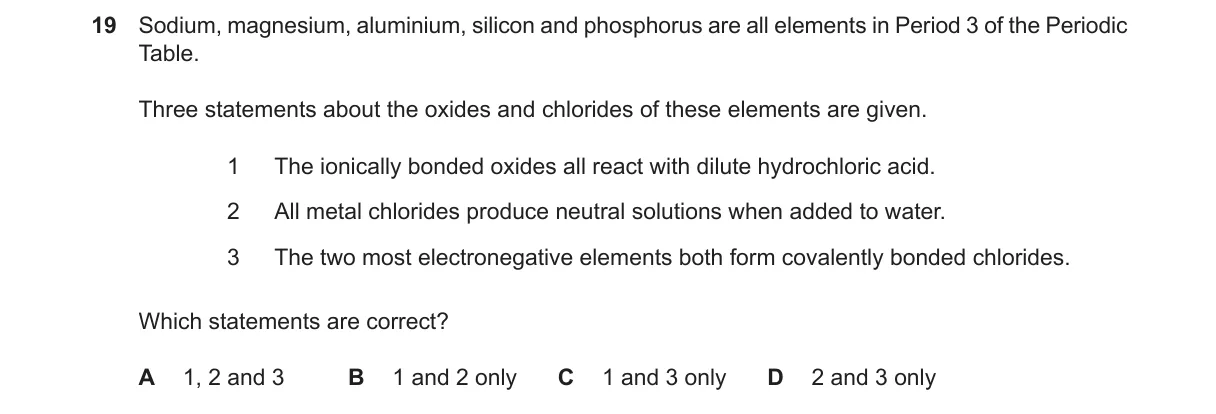
Answer choices
- A1, 2 and 3
- B1 and 2 only
- C1 and 3 only
- D2 and 3 only
Explanation
Period 3 Oxides and Chlorides Bonding and Reactivity
Steps:
- Classify oxides: Na₂O, MgO, Al₂O₃ ionic (basic, react with HCl to form salts); SiO₂, P₄O₁₀ covalent (SiO₂ inert to dilute HCl, P₄O₁₀ reacts but not ionic).
- Evaluate statement 1: Ionic oxides (Na, Mg, Al) dissolve in dilute HCl, producing H₂ or salts, confirming reactivity.
- Evaluate statement 2: NaCl neutral in water; MgCl₂ slightly acidic (Mg²⁺ hydrolysis); AlCl₃ strongly acidic (Al³⁺ hydrolysis to [Al(H₂O)₆]³⁺), so not all neutral.
- Evaluate statement 3: Most electronegative are Si (1.8) and P (2.1); SiCl₄ and PCl₅ covalent (low electronegativity difference with Cl).
Why C is correct:
- C selects statements 1 and 3, matching ionic oxide acidity (Brønsted-Lowry: bases accept H⁺ from HCl) and covalent chlorides (Pauling rule: ΔEN < 1.7 indicates covalent bonding).
Why the others are wrong:
- A includes 2, but AlCl₃ hydrolysis produces acidic solutions.
- B includes 2, ignoring hydrolysis acidity in MgCl₂ and AlCl₃.
- D excludes 1, but ionic oxides react per acid-base theory.
Final answer: C
Topic: The Periodic Table: chemical periodicity
Practice more A Levels Chemistry (9701) questions on mMCQ.me