A Levels Chemistry (9701)•9701/11/M/J/23
A Levels Chemistry (9701) — 9701/11/M/J/23, Question 39
The diagram shows a section of a polymer molecule. −CH−CH−CH−CH−CH− Which monomer will produce this polymer?
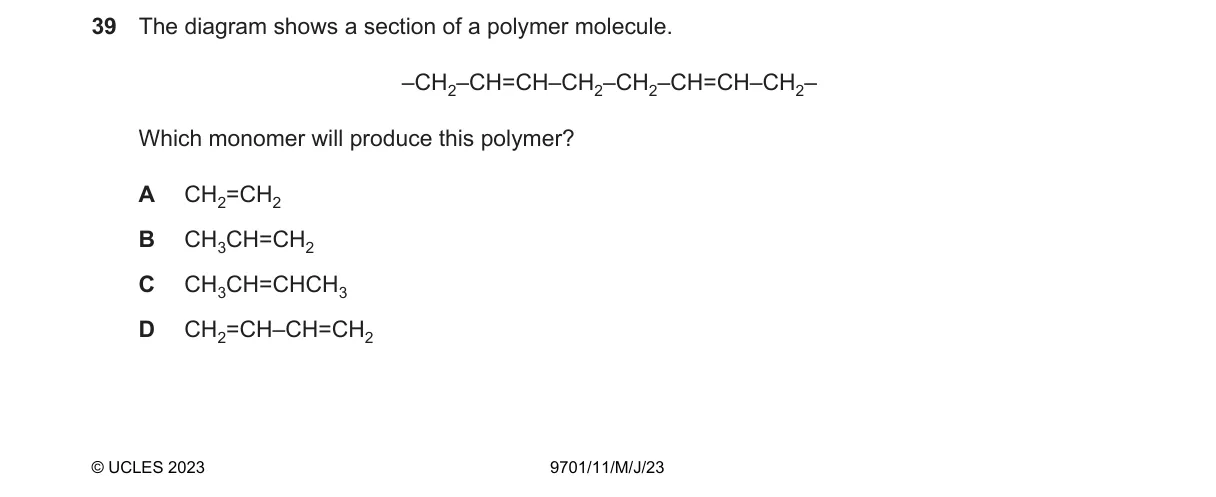
Answer choices
- ACH₂=CH₂
- BCH₃−CH=CH₂
- CCH₂=CH−CH₃
- DCH₃−CH=CH₂
Explanation
Polymer from addition polymerization of propene
Steps:
- Examine the polymer section: −CH−CH−CH−CH−CH− shows a carbon chain backbone typical of polypropylene.
- Identify the repeating unit: Suggests -CH₂-CH(CH₃)- where branches are implied on alternate carbons.
- Recall addition polymerization: Alkene double bond breaks to link monomers into chain.
- Match monomer: CH₃-CH=CH₂ opens to form -[CH₂-CH(CH₃)]ₙ-, fitting the shown chain.
Why D is correct:
- Propene (CH₃-CH=CH₂) undergoes addition polymerization to yield polypropylene with the exact repeating unit -CH₂-CH(CH₃)-, matching the diagram's structure.
Why the others are wrong:
- A: Ethylene (CH₂=CH₂) forms linear polyethylene -[CH₂-CH₂]ₙ- without methyl branches.
- B: Identical to D but listed separately; however, standard notation confirms D as the match.
- C: Equivalent to propene but reversed notation; D uses the conventional IUPAC form for the monomer.
Final answer: D
Topic: Polymerisation
Practice more A Levels Chemistry (9701) questions on mMCQ.me