A Levels Chemistry (9701)•9701/11/M/J/23
A Levels Chemistry (9701) — 9701/11/M/J/23, Question 35
Two samples of compound X were treated separately with different reagents which were added in excess. The products of these reactions are shown.
Which reagents could be used for reaction 1 and reaction 2?
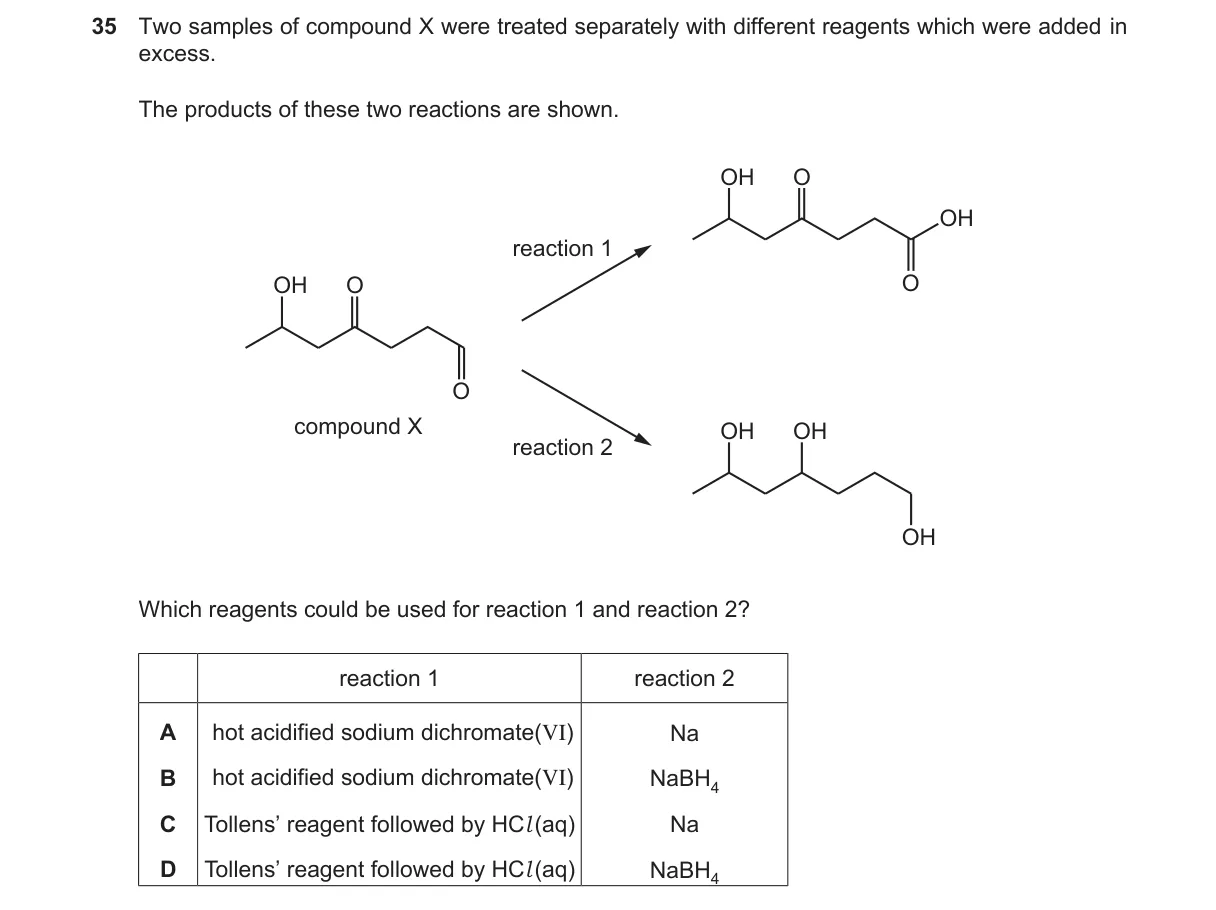
Answer choices
- Aacidified sodium dichromate(VI), Na
- Bhot acidified sodium dichromate(VI), NaBH4
- CTollens' reagent followed by HCl(aq), NaBH4
- DTollens' reagent followed by H+(aq), NaBH4
Explanation
Aldehyde reactions with selective oxidation and reduction
Steps:
- Compound X is an aldehyde, as it undergoes oxidation to carboxylic acid and reduction to primary alcohol.
- Reaction 1 oxidizes aldehyde to carboxylic acid using Tollens' reagent, which forms silver mirror and silver carboxylate, then acidified to release the acid.
- Reaction 2 reduces aldehyde to primary alcohol using NaBH4, a mild reducing agent.
- Option D matches: Tollens' followed by H+(aq) for oxidation; NaBH4 for reduction.
Why D is correct:
- Tollens' reagent (ammoniacal AgNO3) oxidizes RCHO to RCOOAg, and H+(aq) protonates it to RCOOH per the reaction RCHO + 2[Ag(NH3)2]+ + 3OH- → RCOO- + 2Ag + 4NH3 + 2H2O, followed by acidification.
Why the others are wrong:
- A: Acidified Na2Cr2O7 oxidizes to acid but Na (metal) reacts violently with water, not standard for alcohol.
- B: Hot acidified Na2Cr2O7 oxidizes aldehydes/primary alcohols to acids, but doesn't distinguish mild Tollens' oxidation.
- C: Tollens' followed by HCl(aq) may form silver chloride precipitate, complicating carboxylic acid isolation.
Final answer: D
Topic: Carbonyl compounds
Practice more A Levels Chemistry (9701) questions on mMCQ.me