A Levels Chemistry (9701)•9701/11/M/J/23
A Levels Chemistry (9701) — 9701/11/M/J/23, Question 31
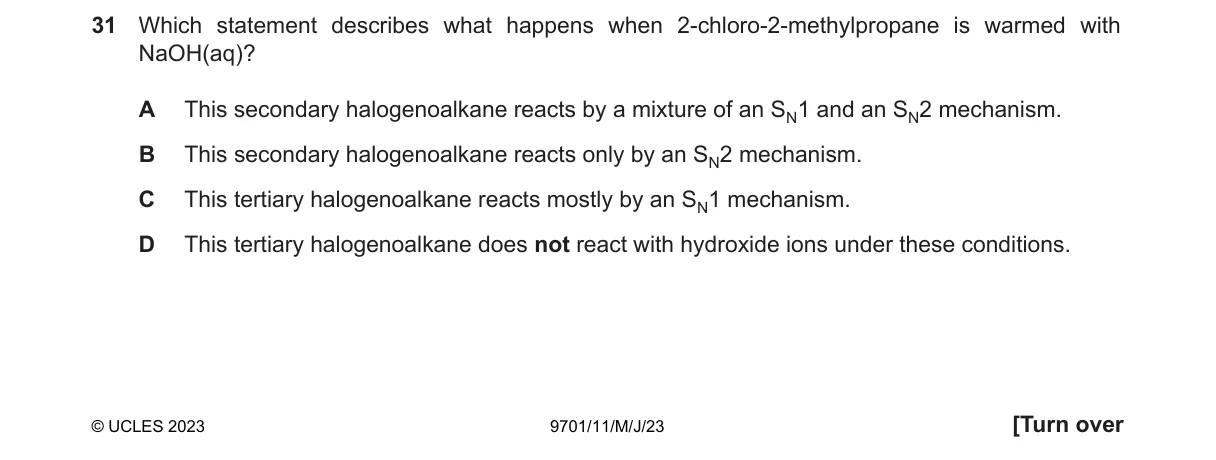
Which statement describes what happens when 2-chloro-2-methylpropane is warmed with NaOH(aq)?
Answer choices
- AThis secondary haloalkane reacts by a mixture of SN1 and SN2 mechanisms.
- BThis secondary haloalkane reacts only by an SN2 mechanism.
- CThis tertiary haloalkane reacts mostly by an SN1 mechanism.
- DThis tertiary haloalkane does not react with hydroxide ions under these conditions.
Explanation
Tertiary Haloalkane SN1 Reaction
Steps:
- Identify 2-chloro-2-methylpropane as (CH₃)₃CCl, with Cl on a carbon attached to three alkyl groups.
- Classify it as tertiary because the carbon bearing Cl has three substituents.
- Recall that tertiary haloalkanes with aqueous NaOH favor SN1 due to carbocation stability and polar protic solvent.
- Select option matching tertiary classification and predominant SN1 mechanism.
Why C is correct:
- Tertiary haloalkanes undergo SN1 via carbocation intermediate, as the tertiary carbocation is stabilized by hyperconjugation and inductive effects.
Why the others are wrong:
- A: Incorrectly labels it secondary; tertiary favors SN1 over SN2.
- B: Incorrectly labels it secondary and claims only SN2, but tertiary sterics block SN2.
- D: Tertiary haloalkanes do react with OH⁻ via SN1 to form alcohols.
Final answer: C
Topic: Halogen compounds
Practice more A Levels Chemistry (9701) questions on mMCQ.me