A Levels Chemistry (9701)•9701/11/M/J/23
A Levels Chemistry (9701) — 9701/11/M/J/23, Question 28
Structural isomerism and stereoisomerism should be considered when answering this question. A set of isomeric hydrocarbons: • all contain 14.3% by mass of hydrogen • each hydrocarbon reacts with 0.79g of bromine by addition, 0.28g of each hydrocarbon reacting with 0.79g of bromine What is the maximum number of isomers
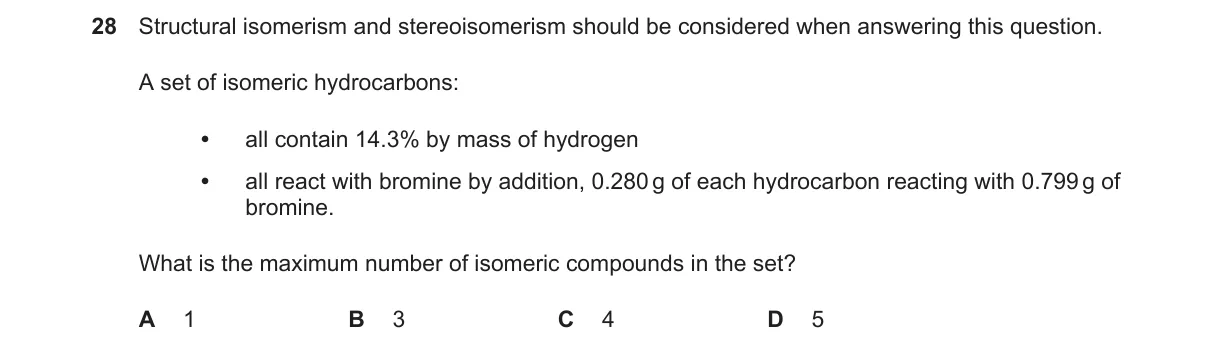
Answer choices
- A1
- B3
- C4
- D5
Explanation
C4H8 alkenes with one double bond
Steps:
- Hydrogen mass percent 14.3% gives empirical formula CH2; combined with Br2 addition data, molecular formula is C4H8 (molar mass 56 g/mol from 0.28 g hydrocarbon : 0.79 g Br2 ≈ 1:1 mole ratio for one double bond).
- C4H8 indicates one degree of unsaturation, consistent with alkenes adding one Br2 molecule.
- Structural isomers: 1-butene, 2-butene, 2-methylpropene (cycloalkanes excluded as they do not undergo addition).
- Stereoisomers: 2-butene has cis and trans forms; others have none, totaling four isomers.
Why C is correct:
- Four C4H8 alkenes (1-butene, cis-2-butene, trans-2-butene, 2-methylpropene) each add one Br2, matching the reaction stoichiometry per alkene addition rule.
Why the others are wrong:
- A: Only one would ignore structural and stereoisomers.
- B: Misses one structural or stereo variant.
- D: Includes non-adding cycloalkanes like cyclobutane, violating addition reaction.
Final answer: C
Topic: Hydrocarbons
Practice more A Levels Chemistry (9701) questions on mMCQ.me