A Levels Chemistry (9701)•9701/11/M/J/23
A Levels Chemistry (9701) — 9701/11/M/J/23, Question 27
Which equation represents a reaction that proceeds through initiation, propagation and termination steps?
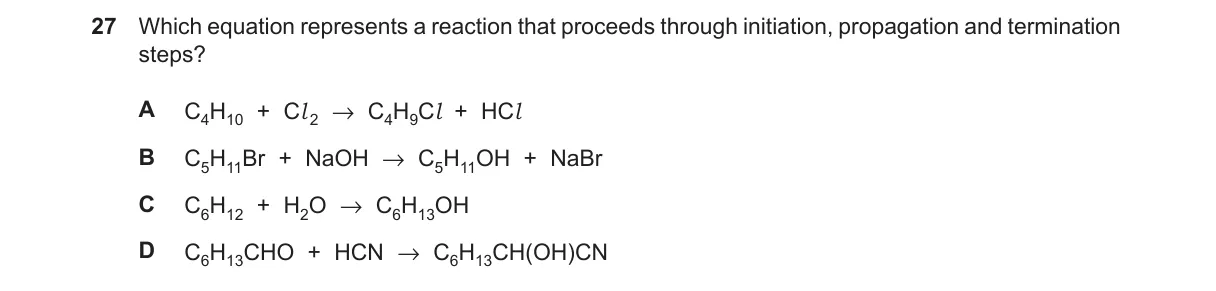
Answer choices
- ACH₃CH₂Cl + Cl₂ → CH₃CH₂Cl + HCl
- BCH₃CH₂Br + NaOH → CH₃CH₂OH + NaBr
- CCH₃CH₂OH + HBr → CH₃CH₂Br + H₂O
- DCH₃CH₂OH + HCN → CH₃CH₂OHCN
Explanation
Free Radical Chain Reaction Steps:
- Identify reactions involving initiation (radical formation), propagation (radical chain), and termination (radical recombination).
- Examine each equation for halogenation, a classic free radical process.
- Rule out ionic or nucleophilic substitutions lacking chain steps.
- Confirm A matches radical chlorination of alkanes.
Why A is correct:
- Chlorination of ethyl chloride (or alkane analog) follows free radical mechanism with Cl• initiation by light/heat, propagation via H-abstraction and Cl-addition, and termination by radical coupling, per chain reaction theory.
Why the others are wrong:
- B: Nucleophilic substitution (SN2) of alkyl bromide with OH⁻, no radicals.
- C: Acid-catalyzed SN1/SN2 conversion of alcohol to bromide, ionic mechanism.
- D: Unclear reaction (possibly cyanohydrin, but invalid for alcohol); lacks chain steps.
Final answer: A
Topic: Hydrocarbons
Practice more A Levels Chemistry (9701) questions on mMCQ.me