A Levels Chemistry (9701)•9701/11/M/J/23
A Levels Chemistry (9701) — 9701/11/M/J/23, Question 23
A solution contains both Mg²⁺(aq) and Sr²⁺(aq) at the same concentration. The solution is divided into two equal portions. Aqueous sodium hydroxide is added dropwise to one portion. Dilute sulfuric acid is added dropwise to the other portion.
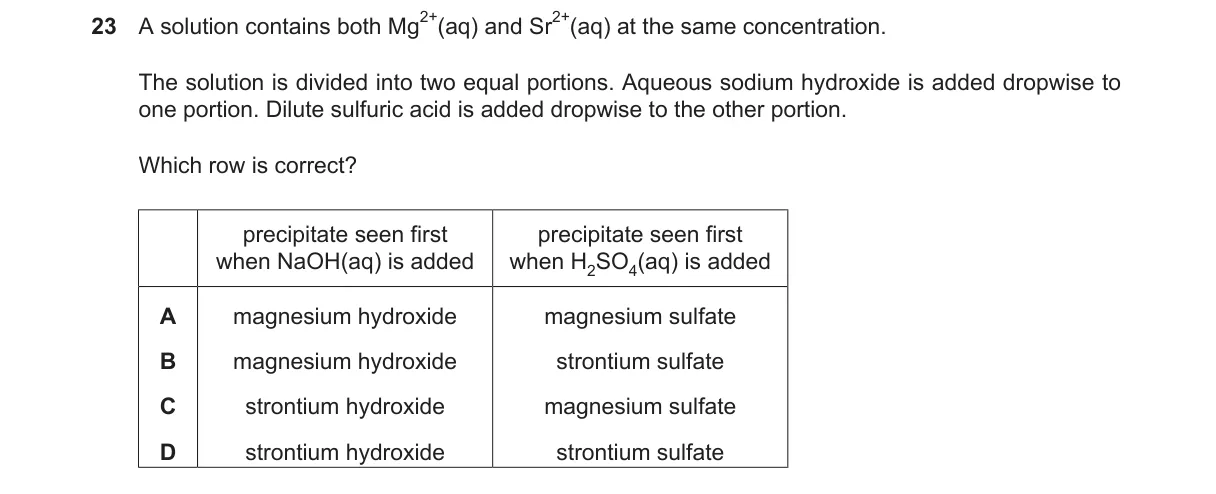
Answer choices
- Amagnesium hydroxide, magnesium sulfate
- Bmagnesium hydroxide, strontium sulfate
- Cstrontium hydroxide, magnesium sulfate
- Dstrontium hydroxide, strontium sulfate
Explanation
Selective precipitation by solubility differences
Steps:
- Compare Ksp values: Mg(OH)₂ (5.61 × 10^{-12}) < Sr(OH)₂ (3.2 × 10^{-4}), so Mg(OH)₂ precipitates first with NaOH.
- With dilute H₂SO₄, compare Ksp: SrSO₄ (3.44 × 10^{-7}) << MgSO₄ (highly soluble, ~10^0), so SrSO₄ precipitates first.
- Equal concentrations mean the less soluble compound in each pair forms the initial precipitate dropwise.
- Thus, NaOH portion yields Mg(OH)₂; H₂SO₄ portion yields SrSO₄.
Why B is correct:
- B matches the precipitates: Mg(OH)₂ from lower Ksp hydroxide, SrSO₄ from lower Ksp sulfate, per solubility product principle.
Why the others are wrong:
- A: SrSO₄, not MgSO₄, precipitates due to SrSO₄'s much lower Ksp.
- C: Mg(OH)₂, not Sr(OH)₂, precipitates as it has lower Ksp; MgSO₄ does not precipitate.
- D: Mg(OH)₂, not Sr(OH)₂, forms first; MgSO₄ remains soluble.
Final answer: B
Topic: Group 2
Practice more A Levels Chemistry (9701) questions on mMCQ.me