A Levels Chemistry (9701)•9701/11/M/J/23
A Levels Chemistry (9701) — 9701/11/M/J/23, Question 19
Element X has the second largest atomic radius in its period. An atom of X has three occupied electron shells only. The oxide of X is shaken with water. What could be the pH of the resulting solution?
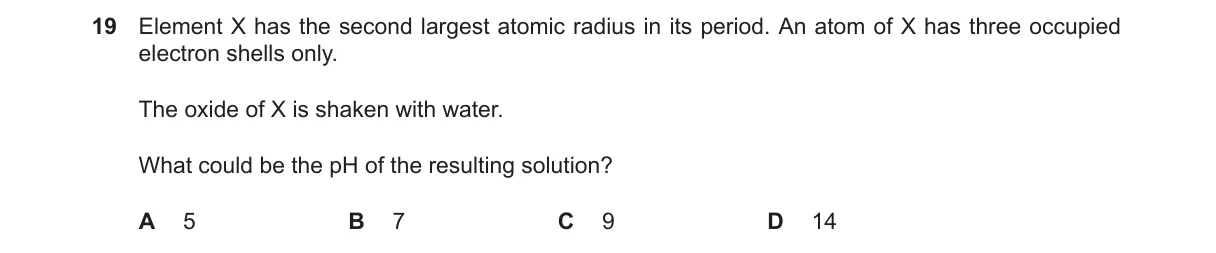
Answer choices
- A5
- B7
- C9
- D14
Explanation
Element X is magnesium in period 3, forming a basic oxide solution.
Steps:
- Three occupied shells place X in period 3 (Na to Ar).
- Atomic radii decrease across period 3; Na has the largest, so second largest is Mg (group 2).
- Mg oxide is MgO, which reacts with water: MgO + H₂O → Mg(OH)₂.
- Mg(OH)₂ is a weak base, producing OH⁻ ions for pH > 7.
Why C is correct:
- Basic oxides of group 2 metals like MgO form weakly alkaline solutions with pH around 9, per the Arrhenius definition of bases increasing [OH⁻].
Why the others are wrong:
- A: pH 5 indicates acidity, but metal oxides produce basic solutions.
- B: pH 7 is neutral, not matching the basic nature of group 2 oxides.
- D: pH 14 is strongly basic, exceeding the weak basicity of Mg(OH)₂.
Final answer: C
Topic: Group 2
Practice more A Levels Chemistry (9701) questions on mMCQ.me