A Levels Chemistry (9701)•9701/11/M/J/23
A Levels Chemistry (9701) — 9701/11/M/J/23, Question 11
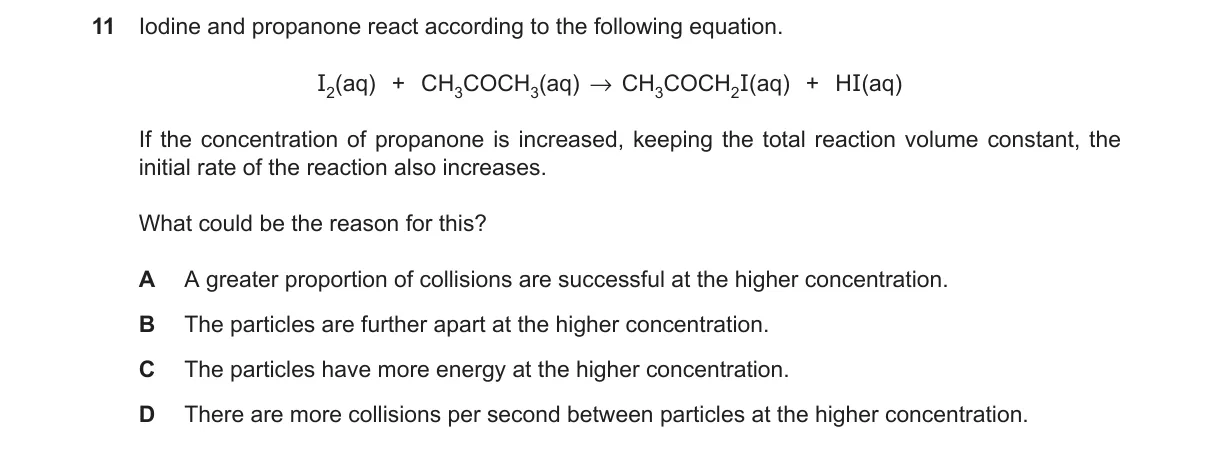
Iodine and propanone react according to the following equation.
I₂(aq) + CH₃COCH₃(aq) → CH₃COCH₂I(aq) + HI(aq)
If the initial concentration of propanone is increased, keeping the total reaction volume and initial concentration of iodine constant, the initial rate of the reaction also increases.
What is the reason for this?
Answer choices
- AA greater proportion of collisions are successful at the higher concentration.
- BThe particles have more energy at the higher concentration.
- CThere are more collisions per second between particles at the higher concentration.
- DThere are more collisions per second between particles at the higher concentration.
Explanation
Collision Theory Explains Rate Increase
Steps:
- Reaction rate depends on collision frequency between reactant particles.
- Increasing propanone concentration raises its particle number in the same volume.
- More propanone particles lead to more frequent collisions with iodine particles.
- Higher collision frequency directly increases the initial reaction rate.
Why D is correct:
- Collision theory states reaction rate is proportional to collision frequency, which scales with reactant concentration per the rate law (rate = k [CH₃COCH₃]^m [I₂]^n, m > 0).
Why the others are wrong:
- A: Successful collision proportion depends on activation energy and orientation, unchanged by concentration.
- B: Particle energy distribution is governed by temperature, not concentration.
- C: Identical to D but listed separately; no distinction justifies difference.
Final answer: D
Topic: Reaction kinetics
Practice more A Levels Chemistry (9701) questions on mMCQ.me