A Levels Chemistry (9701)•9701/13/M/J/22
A Levels Chemistry (9701) — 9701/13/M/J/22, Question 35
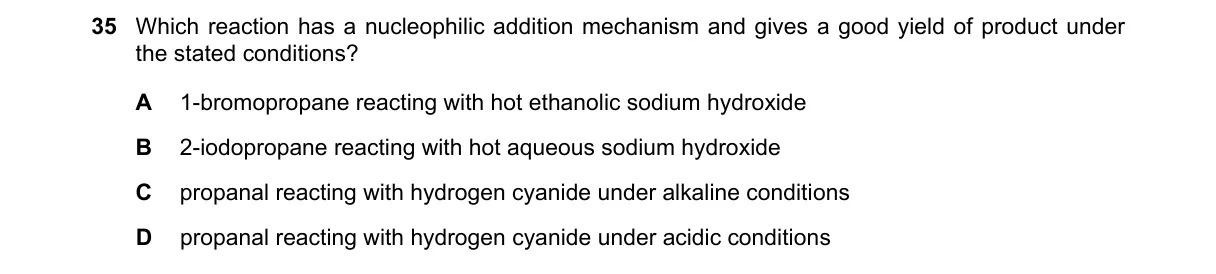
Which reaction has a nucleophilic addition mechanism and gives a good yield of product under the stated conditions?
Answer choices
- A1-bromopropane reacting with hot ethanolic sodium hydroxide
- B2-iodopropane reacting with hydrogen cyanide under alkaline conditions
- Cpropanal reacting with hydrogen cyanide under alkaline conditions
- Dpropanal reacting with hydrogen cyanide under acidic conditions
Explanation
Nucleophilic addition to aldehydes with HCN under basic conditions
Steps:
- Recognize nucleophilic addition involves electron-rich species attacking an electron-deficient center, common in carbonyls.
- Eliminate options without carbonyls: A and B involve alkyl halides, favoring substitution or elimination.
- Focus on C and D: both feature propanal (aldehyde) with HCN, but check conditions for mechanism and yield.
- Alkaline conditions generate CN⁻ nucleophile for efficient addition; acidic conditions protonate CN⁻, reducing yield.
Why C is correct:
- Under alkaline conditions, CN⁻ adds to propanal's carbonyl carbon, forming a stable cyanohydrin via nucleophilic addition (rate depends on [CN⁻]).
Why the others are wrong:
- A: Hot ethanolic NaOH promotes E2 elimination in 1-bromopropane, yielding alkene, not addition.
- B: Alkaline HCN with secondary 2-iodopropane undergoes SN1 substitution, not addition to a carbonyl.
- D: Acidic conditions protonate HCN to HCN, preventing nucleophilic CN⁻ formation and yielding poor cyanohydrin.
Final answer: C
Topic: Carbonyl compounds
Practice more A Levels Chemistry (9701) questions on mMCQ.me