A Levels Chemistry (9701)•9701/13/M/J/22
A Levels Chemistry (9701) — 9701/13/M/J/22, Question 23
Chlorine and bromine have different volatilities. Which row identifies the more volatile of the two elements, and gives the correct explanation?
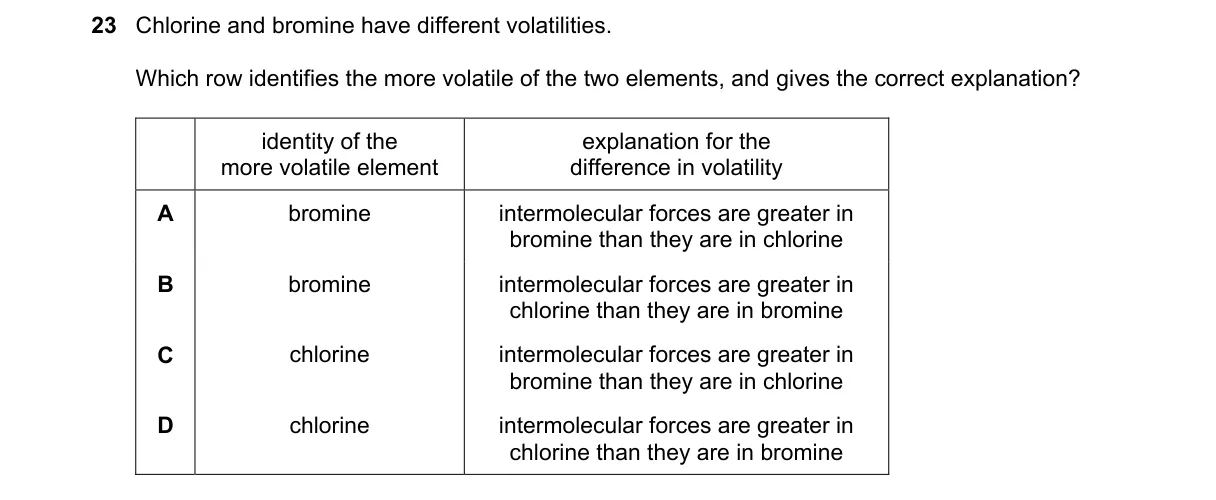
Answer choices
- Abromine intermolecular forces are greater in bromine than they are in chlorine
- Bbromine intermolecular forces are greater in chlorine than they are in bromine
- Cchlorine intermolecular forces are greater in bromine than they are in chlorine
- Dchlorine intermolecular forces are greater in chlorine than they are in bromine
Explanation
Volatility and Intermolecular Forces in Halogens
Steps:
- Volatility measures how easily a substance evaporates, inversely related to boiling point.
- Boiling point rises with stronger intermolecular forces in similar molecules.
- Chlorine (Cl₂) and bromine (Br₂) are nonpolar diatomic gases/liquids with London dispersion forces.
- Dispersion forces strengthen down Group 17 due to increasing atomic size and polarizability, so Br₂ has stronger forces than Cl₂, making Cl₂ more volatile.
Why C is correct:
- C identifies chlorine as more volatile because intermolecular forces are greater in bromine (Br₂) than chlorine (Cl₂), aligning with dispersion force trends that raise Br₂'s boiling point (59°C vs. Cl₂'s -34°C).
Why the others are wrong:
- A: Wrongly names bromine as more volatile despite correctly noting stronger forces in Br₂ (which implies lower volatility for Br₂).
- B: Wrongly names bromine as more volatile and falsely claims stronger forces in Cl₂ than Br₂.
- D: Correctly names chlorine as more volatile but falsely claims stronger forces in Cl₂ than Br₂.
Final answer: C
Topic: Group 17
Practice more A Levels Chemistry (9701) questions on mMCQ.me