A Levels Chemistry (9701)•9701/13/M/J/22
A Levels Chemistry (9701) — 9701/13/M/J/22, Question 22
Chlorine is bubbled through a cylinder containing aqueous sodium iodide and an immiscible layer of hexane. As the bubbles pass through the cylinder, what is observed in the lower and upper layers?
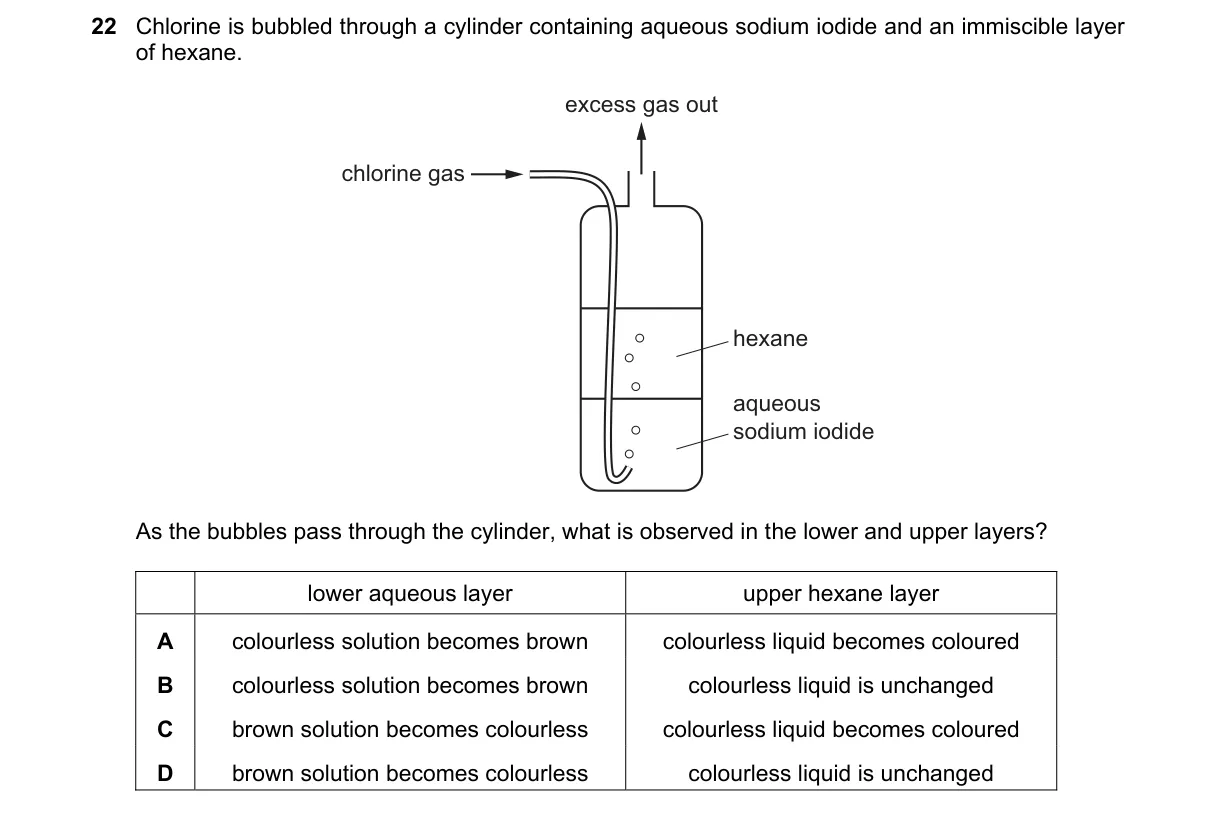
Answer choices
- Alower aqueous layer brown upper hexane layer
- Bcolourless solution becomes brown colourless liquid is unchanged
- Cbrown solution becomes colourless colourless liquid is unchanged
- Dbrown solution becomes colourless colourless liquid unchanged
Explanation
Iodine displacement and partitioning in immiscible layers
Steps:
- Chlorine gas reacts with aqueous NaI: Cl₂ + 2I⁻ → 2Cl⁻ + I₂, liberating iodine.
- Iodine initially colors the lower aqueous layer brown due to solubility in water.
- Excess iodine partitions into the immiscible upper hexane layer, turning it purple-brown.
- Observation: brown lower layer and colored upper layer.
Why A is correct:
- Iodine (I₂) is brown in aqueous media and more soluble in nonpolar hexane, coloring both layers per solubility laws.
Why the others are wrong:
- B: Upper hexane layer changes color as iodine dissolves into it.
- C: Initial aqueous NaI is colorless, not brown; it becomes brown, not colorless.
- D: Same error as C; initial solution is colorless and becomes brown.
Final answer: A
Topic: Group 17
Practice more A Levels Chemistry (9701) questions on mMCQ.me