A Levels Chemistry (9701)•9701/13/M/J/22
A Levels Chemistry (9701) — 9701/13/M/J/22, Question 20
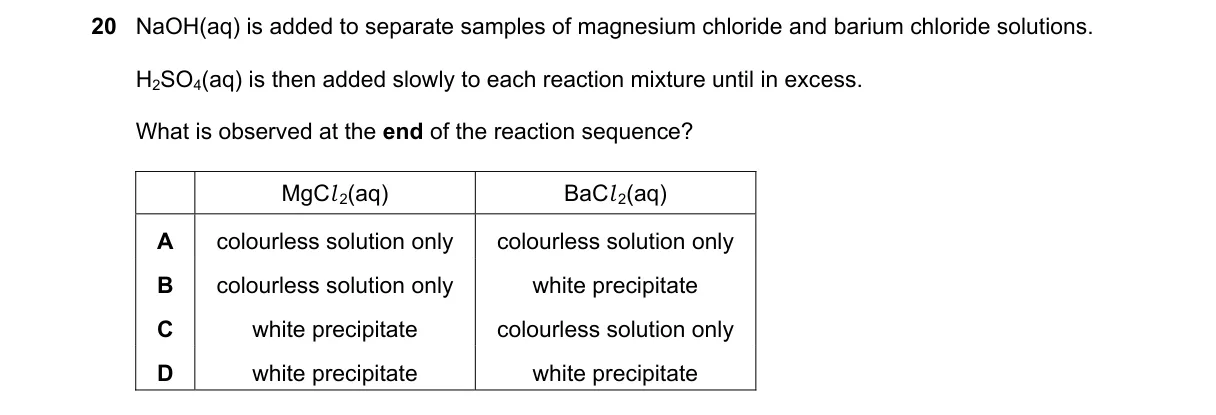
NaOH(aq) is added to separate samples of magnesium chloride and barium chloride solutions. H2SO4(aq) is then added slowly to each reaction mixture until excess. What is observed at the end of each reaction sequence?
Answer choices
- Acolourless solution only, colourless solution only
- Bcolourless solution only, white precipitate
- Cwhite precipitate, colourless solution only
- Dwhite precipitate, white precipitate
Explanation
Solubility differences in group 2 hydroxides and sulfates
Steps:
- NaOH reacts with MgCl₂ to form insoluble Mg(OH)₂ white precipitate.
- NaOH reacts with BaCl₂ to form soluble Ba(OH)₂ colourless solution.
- Excess H₂SO₄ dissolves Mg(OH)₂ into soluble MgSO₄ colourless solution.
- Excess H₂SO₄ reacts with Ba(OH)₂ to form insoluble BaSO₄ white precipitate.
Why B is correct:
- B matches observations: colourless solution for MgCl₂ (MgSO₄ soluble) and white precipitate for BaCl₂ (BaSO₄ insoluble), per solubility rules for group 2 compounds.
Why the others are wrong:
- A: Predicts solutions for both, but ignores BaSO₄ precipitation.
- C: Reverses results; Mg(OH)₂ dissolves, while BaSO₄ forms precipitate.
- D: Predicts precipitates for both, but MgSO₄ remains soluble.
Final answer: B
Topic: Group 2
Practice more A Levels Chemistry (9701) questions on mMCQ.me