A Levels Chemistry (9701)•9701/12/M/J/22
A Levels Chemistry (9701) — 9701/12/M/J/22, Question 33
Primary alcohols can be oxidised to aldehydes using either acidified potassium dichromate(VI) or acidified potassium manganate(VII). The reaction mixtures change colour as the oxidising agent is reduced. What are the colour changes?
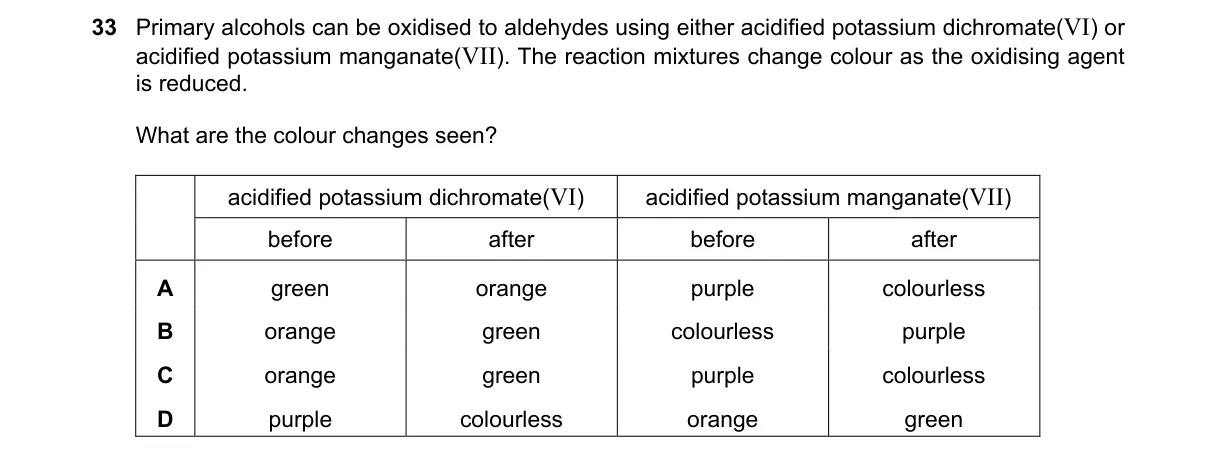
Answer choices
- Aacidified potassium dichromate(VI): green to orange; acidified potassium manganate(VII): purple to colourless
- Bacidified potassium dichromate(VI): orange to green; acidified potassium manganate(VII): colourless to purple
- Cacidified potassium dichromate(VI): orange to green; acidified potassium manganate(VII): purple to purple
- Dacidified potassium dichromate(VI): purple to colourless; acidified potassium manganate(VII): orange to green
Explanation
Oxidizing agent reduction colors in alcohol oxidation
Steps:
- Identify the initial color of acidified K2Cr2O7: orange due to Cr2O7^2- ion.
- Note reduction to Cr^3+ ions produces green color.
- Identify the initial color of acidified KMnO4: purple due to MnO4^- ion.
- Note reduction to Mn^2+ ions produces colorless solution.
Why none are fully correct:
- No option matches both: orange to green for dichromate(VI) and purple to colourless for manganate(VII).
Why the others are wrong:
- A: Dichromate change reversed (green to orange).
- B: Manganate change reversed (colourless to purple).
- C: Manganate shows no change (purple to purple).
- D: Colors swapped and incorrect for both agents.
Not enough information to select an option as all are flawed.
Final answer: None of the options are correct
Topic: Hydroxy compounds
Practice more A Levels Chemistry (9701) questions on mMCQ.me