A Levels Chemistry (9701)•9701/12/M/J/22
A Levels Chemistry (9701) — 9701/12/M/J/22, Question 32
The structure of coniine is shown. Coniine can be synthesised by reacting ammonia with a dibromo compound, X. NH3 + X Br2 → coniine + 2HBr What is compound X?
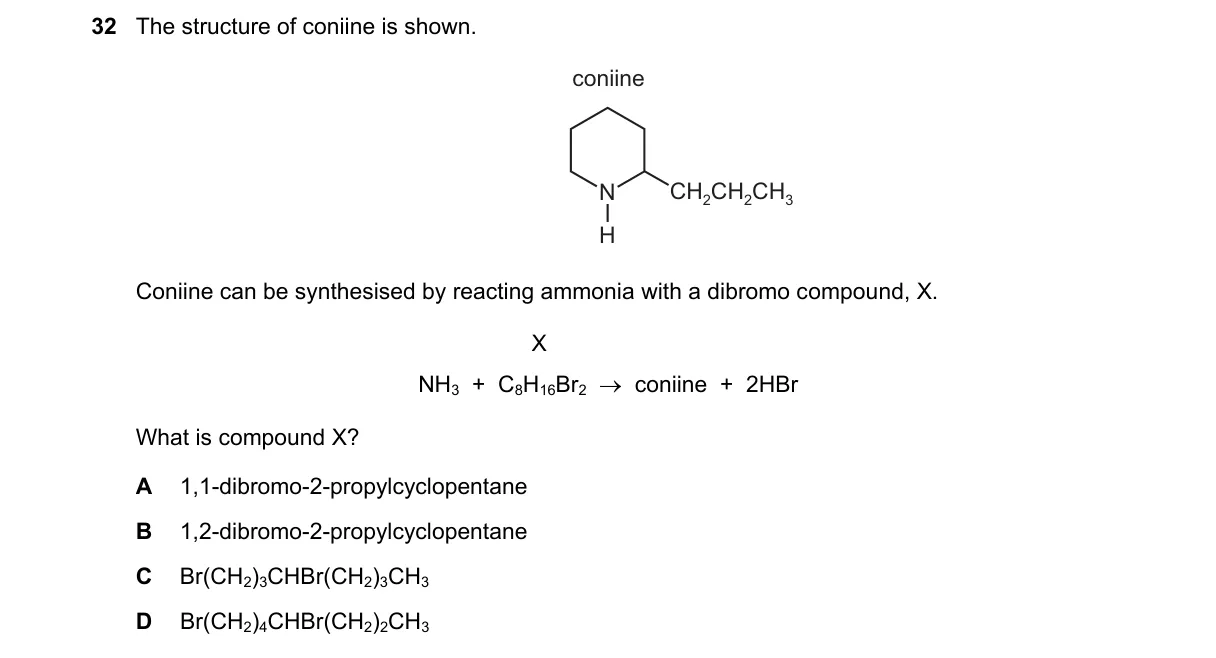
Answer choices
- A1,2-dibromopropylcyclopentane
- B1,2-dibromo-2-propylcyclopentane
- CBrCH2CHBrCH3
- DBrCH2CHBrCH2CH3
Explanation
Vicinal dibromide cyclizes with ammonia to form 2-substituted aziridine Steps:
- Analyze coniine's structure as a 2-alkylaziridine formed via double SN2 by NH3 on vicinal dibromide.
- The dibromide's CH2Br becomes one aziridine CH2; the CHBr-R becomes the substituted CH-R.
- Match R to coniine's alkyl substituent: ethyl requires -CH2CH3 on the second carbon.
- Select the dibromide with four-carbon chain ending in ethyl: BrCH2-CHBr-CH2CH3.
Why D is correct:
- BrCH2CHBrCH2CH3 cyclizes to 2-ethylaziridine, matching coniine's formula and structure via ring closure.
Why the others are wrong:
- A: Cyclopentane ring creates bicyclic product, not simple aziridine.
- B: Propyl and cyclopentane yield complex fused ring, mismatched skeleton.
- C: Forms 2-methylaziridine (from -CH3), wrong alkyl chain length.
Final answer: D
Topic: Organic synthesis
Practice more A Levels Chemistry (9701) questions on mMCQ.me