A Levels Chemistry (9701)•9701/12/M/J/22
A Levels Chemistry (9701) — 9701/12/M/J/22, Question 27
The molecular formula CH3 can represent an anion, a cation or a free radical. Species with the molecular formula CH3 can act as an electrophile, a free radical or a nucleophile depending on the number of outer shell electrons on the central carbon atom. How many outer shell electrons on the central carbon atom must be present for CH3 to act in these different ways
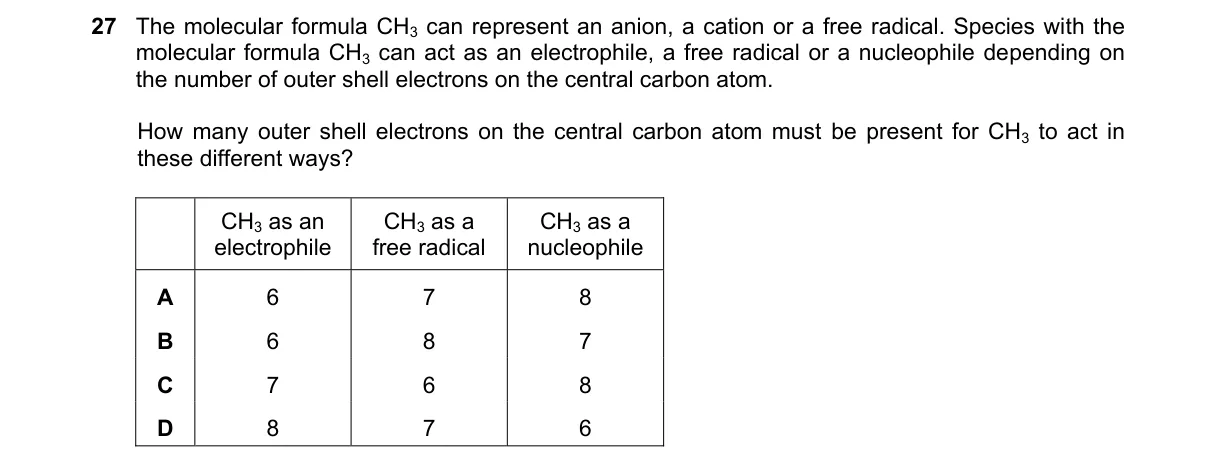
Answer choices
- A6 7 8
- B7 8 7
- C6 8 7
- D8 7 6
Explanation
Electron Count Determines Reactivity in CH3 Species
Steps:
- Carbon has 4 valence electrons; in CH3, bonds with 3 H atoms contribute 3 more electrons to carbon's outer shell.
- For electrophile (CH3+), carbon has 6 electrons (deficient octet, positive charge).
- For free radical (CH3•), carbon has 7 electrons (one unpaired electron).
- For nucleophile (CH3-), carbon has 8 electrons (full octet with lone pair, negative charge).
Why A is correct:
- Matches definitions: electrophiles are electron-poor (6 e-), radicals have odd electrons (7 e-), nucleophiles are electron-rich (8 e-), per Lewis acid-base theory.
Why the others are wrong:
- B: Swaps radical and nucleophile electrons, ignoring nucleophiles need full octet.
- C: Reverses electrophile and radical, contradicting electron deficiency for electrophiles.
- D: Inverts all, mismatching standard reactivity roles.
Final answer: A
Topic: An introduction to organic chemistry
Practice more A Levels Chemistry (9701) questions on mMCQ.me