A Levels Chemistry (9701)•9701/12/M/J/22
A Levels Chemistry (9701) — 9701/12/M/J/22, Question 24
A catalytic converter reduces the amount of pollutants in the fumes from a car exhaust. Which row identifies a pollutant and shows how it is removed by the action of the catalyst?
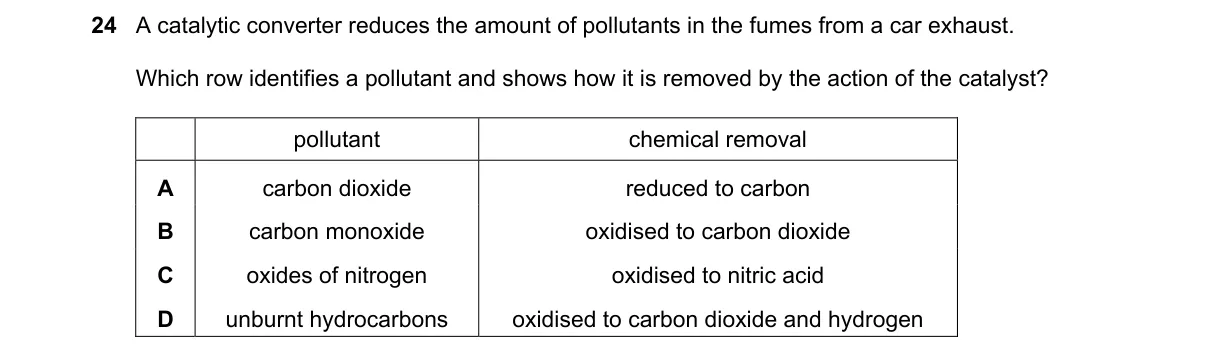
Answer choices
- Acarbon monoxide reduced to carbon dioxide
- Boxides of nitrogen oxidised to nitric acid
- Cunburnt hydrocarbons oxidised to carbon dioxide and hydrogen
- Dunburnt hydrocarbons oxidised to carbon dioxide and hydrogen
Explanation
Catalytic Converter Reactions Steps:
- Identify key pollutants removed: carbon monoxide (CO), unburnt hydrocarbons, and oxides of nitrogen (NOx).
- Recall reactions: CO oxidized to CO2; hydrocarbons oxidized to CO2 and H2O; NOx reduced to N2 and O2.
- Compare each option to these reactions for accuracy in pollutant and process.
- Select the option that best matches a valid removal process despite minor wording issues.
Why A is correct:
- Carbon monoxide is oxidized by the catalyst to carbon dioxide (2CO + O2 → 2CO2), removing the toxic pollutant CO.
Why the others are wrong:
- B: NOx are reduced to N2 and O2 (2NO → N2 + O2), not oxidized to nitric acid (HNO3).
- C: Unburnt hydrocarbons are oxidized to CO2 and water (H2O), not hydrogen gas.
- D: Identical to C, so also incorrect on the product.
Final answer: A
Topic: Chemistry of transition elements
Practice more A Levels Chemistry (9701) questions on mMCQ.me