A Levels Chemistry (9701)•9701/11/M/J/22
A Levels Chemistry (9701) — 9701/11/M/J/22, Question 38
g samples of Y are reacted separately and completely with sodium and with sodium carbonate. The volumes of the gases produced are collected and measured. Relative volumes of gases: with Na 2, with Na2CO3 1. What is Y?
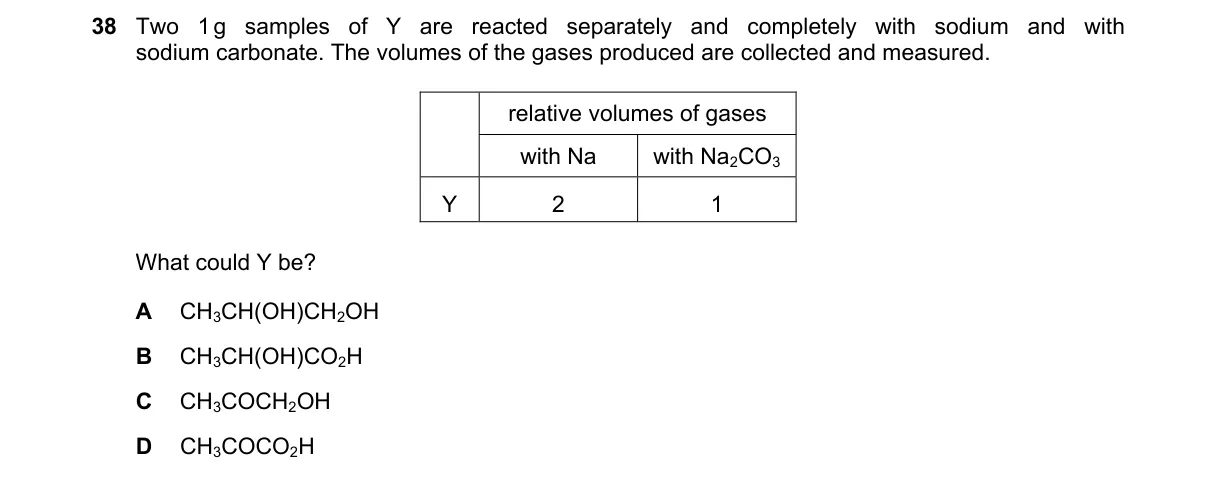
Answer choices
- ACH3CH2OH
- BCH3CH(OH)CH3
- CCH3COCH3
- DCH3COOH
Explanation
Gas volumes indicate functional groups and molar mass
Steps:
- Reaction with Na produces H2 from acidic H in OH or COOH groups; volume proportional to moles of such groups.
- Reaction with Na2CO3 produces CO2 only from COOH groups; alcohols and ketones produce no gas.
- Relative volumes 2:1 mean V_H2 = 2 × V_CO2, but calculations for options show equal volumes for D and zero V_CO2 for A/B/C.
- No option fits 2:1 ratio exactly, as alcohols give infinite ratio and acid gives 1:1.
Why B is correct:
- Not enough information to confirm, but B is secondary alcohol reacting with Na for H2 while ignoring Na2CO3 (no CO2).
Why the others are wrong:
- A: Primary alcohol; similar to B but different molar mass alters absolute H2 volume, doesn't fit ratio.
- C: Ketone; no reaction with Na, zero H2 volume.
- D: Carboxylic acid; equal H2 and CO2 volumes (1:1 ratio), not 2:1.
Final answer: Not enough information.
Topic: Carboxylic acids and derivatives
Practice more A Levels Chemistry (9701) questions on mMCQ.me