A Levels Chemistry (9701)•9701/11/M/J/22
A Levels Chemistry (9701) — 9701/11/M/J/22, Question 35
The skeletal formulae of two organic compounds are shown. Which reagents can be used to distinguish these two compounds? 1 acidified [K2Cr2O7] 2 2,4-dinitrophenylhydrazine (2,4-DNPH reagent) 3 alkaline I2 solution
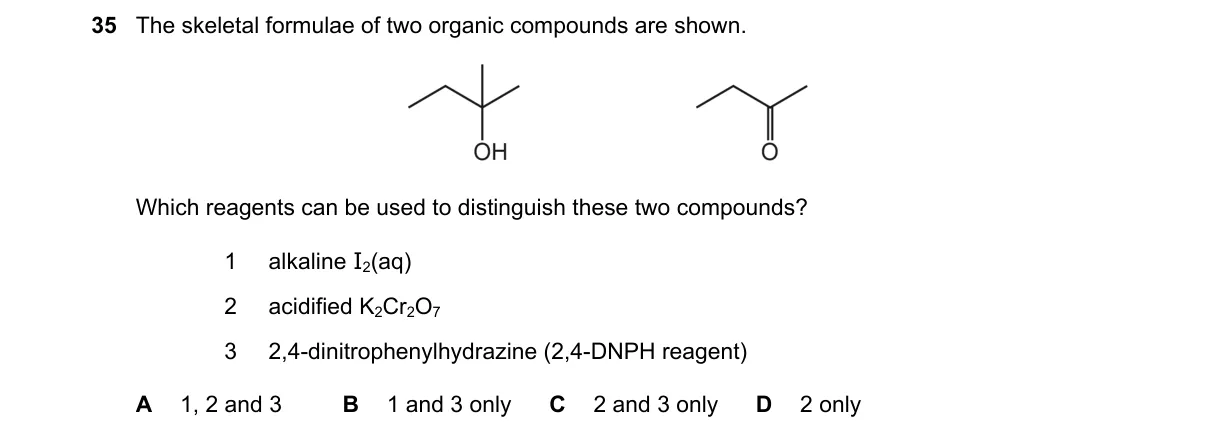
Answer choices
- A1, 2 and 3
- B1 and 3 only
- C2 and 3 only
- D2 only
Explanation
Distinguishing carbonyl compounds using selective reagents
Steps:
- Both compounds react with 2,4-DNPH, forming orange precipitates, indicating both are carbonyls (aldehyde and ketone), so it cannot distinguish them.
- Acidified K2Cr2O7 oxidizes the aldehyde to a carboxylic acid (color change from orange to green), but not the ketone, distinguishing them.
- Alkaline I2 (iodoform test) gives a yellow precipitate with the methyl ketone, but not the aldehyde, distinguishing them.
- Thus, only reagents 1 and 3 differentiate the compounds.
Why B is correct:
- B selects 1 and 3, matching the tests that uniquely react with one carbonyl type per the oxidation and iodoform reaction definitions.
Why the others are wrong:
- A includes 2, which fails to distinguish as both form hydrazones.
- C excludes 1, missing the oxidation distinction for aldehydes.
- D selects only 2, which reacts with both carbonyls indiscriminately.
Final answer: B
Topic: Carbonyl compounds
Practice more A Levels Chemistry (9701) questions on mMCQ.me