A Levels Chemistry (9701)•9701/11/M/J/22
A Levels Chemistry (9701) — 9701/11/M/J/22, Question 29
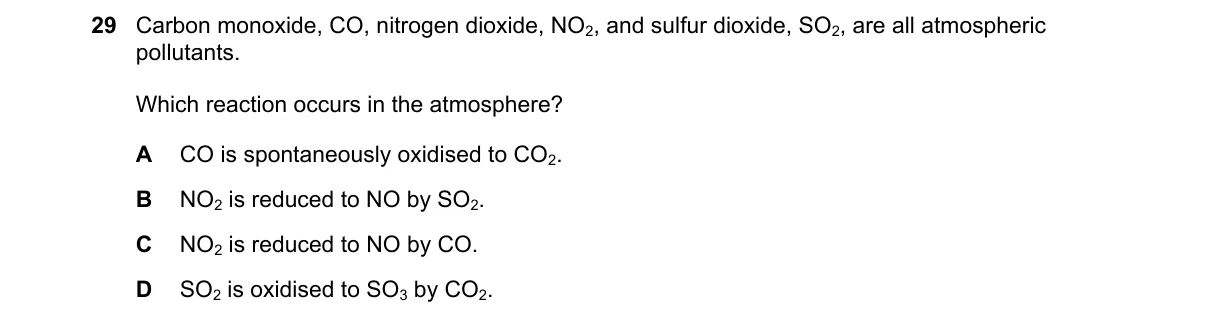
Carbon monoxide, CO, nitrogen dioxide, NO, and sulfur dioxide, SO, are all atmospheric pollutants. Which reaction occurs in the atmosphere?
Answer choices
- ACO is spontaneously oxidised to CO2
- BNO2 is reduced to NO by SO2
- CSO2 is oxidised to SO3 by CO
- DNO is reduced to N2 by CO
Explanation
Atmospheric redox reactions among pollutants
Steps:
- Recall common atmospheric interactions: SO2 acts as a reducing agent for NO2.
- Examine option B: NO2 gains electrons from SO2, forming NO and SO3.
- Verify against known chemistry: This reaction contributes to acid rain precursors.
- Eliminate others by checking if they align with pollutant behaviors.
Why B is correct:
- The reaction NO2 + SO2 → NO + SO3 exemplifies SO2 reducing NO2, a documented atmospheric process forming photochemical smog components.
Why the others are wrong:
- A: CO oxidation to CO2 requires catalysts or UV light, not spontaneous in air.
- C: CO is a reducing agent, not oxidizing SO2 to SO3.
- D: NO reduction to N2 by CO occurs in catalytic converters, not naturally in the atmosphere.
Final answer: B
Topic: Nitrogen and sulfur
Practice more A Levels Chemistry (9701) questions on mMCQ.me