A Levels Chemistry (9701)•9701/11/M/J/22
A Levels Chemistry (9701) — 9701/11/M/J/22, Question 23
Silicon heated in excess chlorine, producing compound J. An excess of water is added to the sample of J produced. Which row is correct?
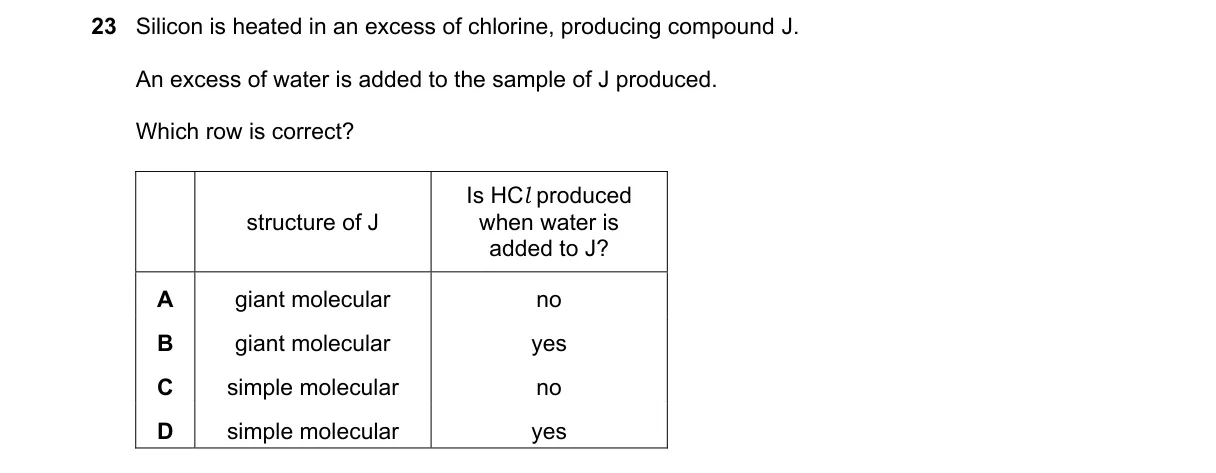
Answer choices
- Agiant molecular no
- Bsimple molecular yes
- Cgiant molecular yes
- Dsimple molecular yes
Explanation
Silicon tetrachloride's molecular structure and hydrolysis
Steps:
- Silicon heated in excess chlorine forms SiCl₄ (compound J).
- SiCl₄ consists of discrete tetrahedral molecules held by weak van der Waals forces, making it simple molecular.
- Adding excess water hydrolyzes SiCl₄: SiCl₄ + 4H₂O → Si(OH)₄ + 4HCl, confirming it reacts.
- Thus, J is simple molecular and reacts with water (yes).
Why D is correct:
- SiCl₄ is a covalent simple molecular compound that undergoes hydrolysis with water, matching the "simple molecular yes" description.
Why the others are wrong:
- A: SiCl₄ is simple molecular, not giant molecular.
- B: SiCl₄ reacts with water, so "no" is incorrect.
- C: SiCl₄ lacks an extended lattice, so it is not giant molecular.
Final answer: D
Topic: The Periodic Table: chemical periodicity
Practice more A Levels Chemistry (9701) questions on mMCQ.me