A Levels Chemistry (9701)•9701/11/M/J/22
A Levels Chemistry (9701) — 9701/11/M/J/22, Question 19
A student reacts 0.100 mol of each sodium, magnesium and phosphorus atoms separately with excess oxygen.
Which rows are correct?
| | oxide | mass of oxide formed/g |
| 1 | sodium | 3.10 |
| 2 | magnesium | 3.10 |
| 3 | phosphorus | 7.10 |
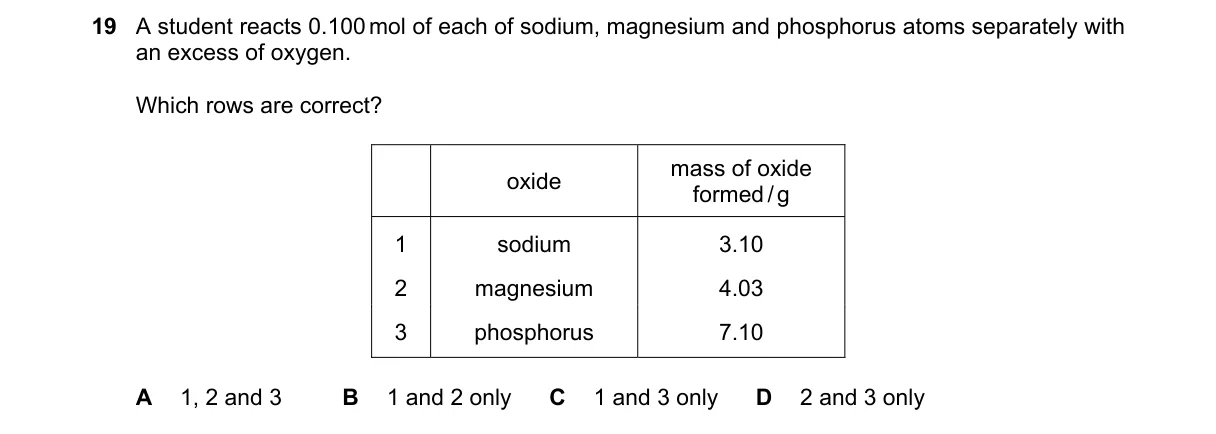
Answer choices
- A1,2 and 3
- B1 and 2 only
- C1 and 3 only
- D2 and 3 only
Explanation
Calculate oxide masses from element formulas and molar masses Steps:
- Sodium forms Na₂O (2 Na + ½ O₂ → Na₂O, molar mass 62 g/mol); 0.100 mol Na yields 0.050 mol Na₂O, mass = 0.050 × 62 = 3.10 g.
- Magnesium forms MgO (Mg + ½ O₂ → MgO, molar mass 40 g/mol); 0.100 mol Mg yields 0.100 mol MgO, mass = 0.100 × 40 = 4.00 g.
- Phosphorus forms P₄O₁₀ (P₄ + 5 O₂ → P₄O₁₀, molar mass 284 g/mol); 0.100 mol P yields 0.025 mol P₄O₁₀, mass = 0.025 × 284 = 7.10 g. Why C is correct:
- Rows 1 and 3 match calculated masses using standard oxide formulas and atomic masses (Na=23, Mg=24, P=31, O=16). Why the others are wrong:
- A includes row 2, but magnesium oxide mass is 4.00 g, not 3.10 g.
- B excludes row 3, but phosphorus oxide mass is correctly 7.10 g.
- D excludes row 1, but sodium oxide mass is correctly 3.10 g.
Final answer: C
Topic: Atoms, molecules and stoichiometry
Practice more A Levels Chemistry (9701) questions on mMCQ.me