A Levels Chemistry (9701)•9701/13/M/J/21
A Levels Chemistry (9701) — 9701/13/M/J/21, Question 33
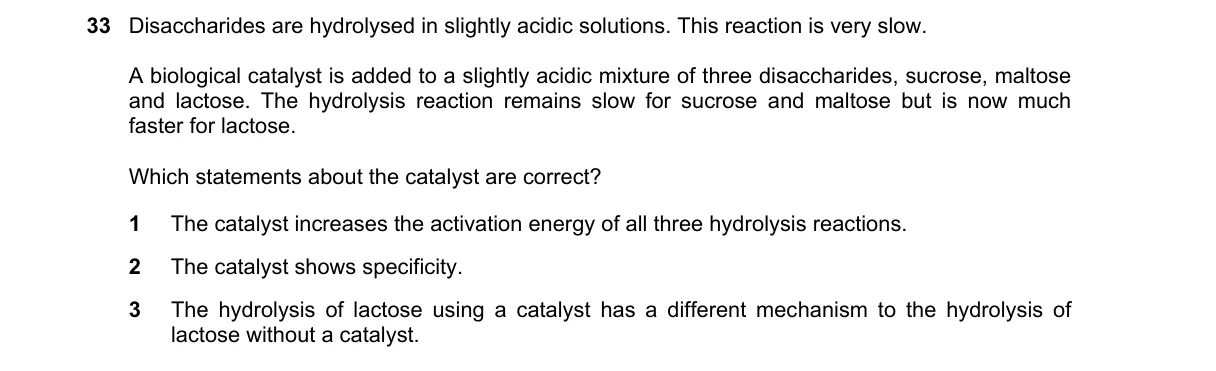
Disaccharides are hydrolyzed in slightly acidic solutions. This reaction is very slow. A biological catalyst is added to a slightly acidic mixture of three disaccharides, sucrose, maltose and lactose. The hydrolysis of lactose remains slow, while the hydrolysis of sucrose and maltose is much faster. Which statements about the catalyst are correct?
Answer choices
- AThe catalyst increases the activation energy of all three hydrolysis.
- BThe hydrolysis of lactose using a catalyst has a different mechanism to the hydrolysis of lactose without a catalyst.
- CThe catalyst shows specificity.
- DOption D
Explanation
Biological Catalyst Specificity
Steps:
- Disaccharides hydrolyze slowly in acid without catalyst.
- Catalyst accelerates sucrose and maltose hydrolysis but not lactose.
- This selective speeding up indicates targeted action on specific substrates.
- Biological catalysts (enzymes) exhibit substrate specificity.
Why C is correct:
- Enzymes show specificity by binding and catalyzing only compatible substrates, like sucrase for sucrose and maltase for maltose, per lock-and-key model.
Why the others are wrong:
- A: Catalysts lower activation energy to speed reactions, not increase it.
- B: Lactose hydrolysis remains uncatalyzed, so mechanism unchanged from acid-only process.
Final answer: C
Topic: Reaction kinetics
Practice more A Levels Chemistry (9701) questions on mMCQ.me