A Levels Chemistry (9701)•9701/13/M/J/21
A Levels Chemistry (9701) — 9701/13/M/J/21, Question 28
Compound Y is treated with a single reagent under suitable conditions. 2-methylbutanoic acid is produced. What could compound Y be?
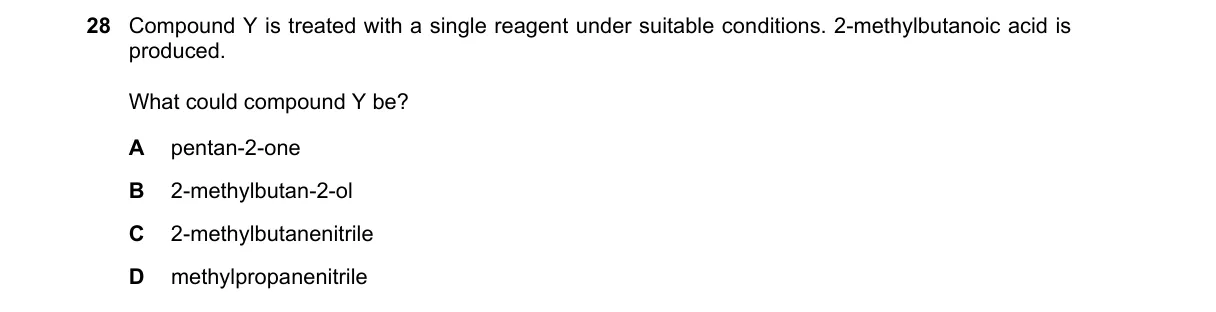
Answer choices
- Apentan-2-one
- B2-methylbutan-2-ol
- C2-methylbutanenitrile
- D2-methylpropanenitrile
Explanation
Nitriles hydrolyze to carboxylic acids with acid or base
Steps:
- Target product is 2-methylbutanoic acid: CH3CH2CH(CH3)COOH.
- Nitriles undergo hydrolysis (R-CN → RCOOH) with single reagent like H3O+ or OH-/H+.
- 2-Methylbutanenitrile is NC-CH(CH3)CH2CH3, so R = CH(CH3)CH2CH3 matches the acid's chain.
- Other options lack this direct conversion or produce wrong products.
Why C is correct:
- Hydrolysis converts the -CN group of 2-methylbutanenitrile to -COOH, yielding exactly 2-methylbutanoic acid.
Why the others are wrong:
- A: Pentan-2-one is a ketone that does not hydrolyze or oxidize to a carboxylic acid with one reagent.
- B: 2-Methylbutan-2-ol is a tertiary alcohol that resists oxidation to carboxylic acids.
- D: 2-Methylpropanenitrile hydrolyzes to 2-methylpropanoic acid, which has a shorter carbon chain.
Final answer: C
Topic: Nitrogen compounds
Practice more A Levels Chemistry (9701) questions on mMCQ.me