A Levels Chemistry (9701)•9701/13/M/J/21
A Levels Chemistry (9701) — 9701/13/M/J/21, Question 27
The diagram shows the structure of a compound formed by the reaction of HCN with a carbonyl compound, X. What is the mechanism of this reaction and the functional group in X?
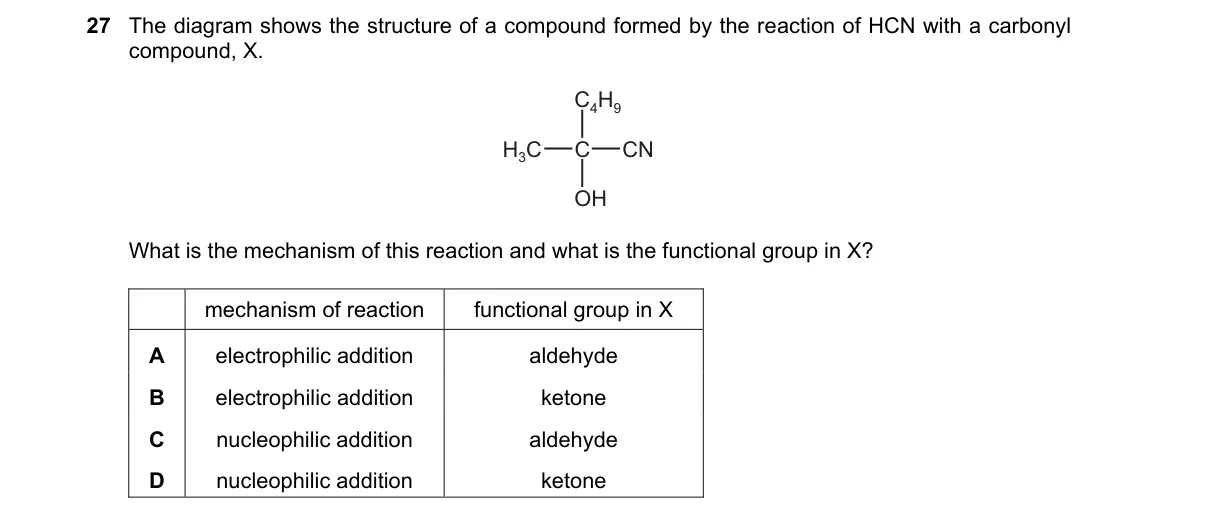
Answer choices
- Aelectrophilic addition aldehyde
- Belectrophilic addition ketone
- Cnucleophilic addition aldehyde
- Dnucleophilic addition ketone
Explanation
Cyanohydrin Formation by Nucleophilic Addition
Steps:
- Carbonyl compounds like aldehydes (RCHO) or ketones (R₂CO) have a polar C=O bond, with electrophilic carbon.
- HCN dissociates to provide CN⁻ nucleophile, which attacks the carbonyl carbon.
- The oxygen gains a proton, forming a cyanohydrin (RCH(OH)CN or R₂C(OH)CN).
- The diagram's structure shows two carbon substituents on the product carbon, indicating X is a ketone (R₂C=O).
Why D is correct:
- Nucleophilic addition to ketones follows the mechanism where CN⁻ adds to R₂C=O, yielding R₂C(OH)CN, matching the product's functional group and structure.
Why the others are wrong:
- A: Electrophilic addition is incorrect; the carbonyl carbon acts as electrophile, attacked by nucleophile CN⁻, not vice versa; aldehyde irrelevant here.
- B: Electrophilic addition wrong; mechanism is nucleophilic, though ketone is correct.
- C: Nucleophilic addition correct, but X is ketone (two R groups), not aldehyde (one R and one H).
Final answer: D
Topic: Carbonyl compounds
Practice more A Levels Chemistry (9701) questions on mMCQ.me