A Levels Chemistry (9701)•9701/13/M/J/21
A Levels Chemistry (9701) — 9701/13/M/J/21, Question 19
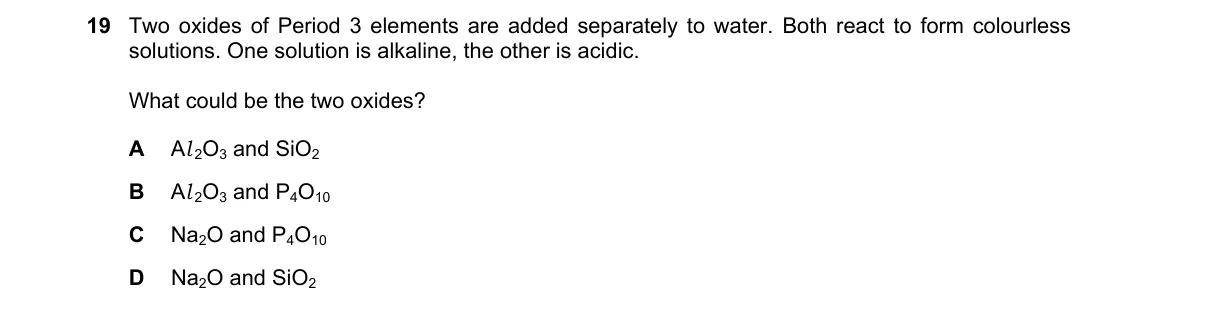
Two oxides of Period 3 elements are added separately to water. Both react to form colourless solutions. One solution is alkaline, the other is acidic. What could the two oxides be?
Answer choices
- AAl₂O₃ and SiO₂
- BAl₂O₃ and P₄O₁₀
- CNa₂O and SiO₂
- DNa₂O and P₄O₁₀
Explanation
Period 3 oxides form acidic or basic solutions with water based on metallic/non-metallic character Steps:
- Basic oxides from left-side elements (e.g., Na) react with water to form alkaline solutions containing OH⁻.
- Acidic oxides from right-side elements (e.g., Si) react with water to form acidic solutions containing H⁺.
- Both oxides must react to produce colourless solutions, one alkaline and one acidic.
- Evaluate options to find the pair matching these criteria.
Why C is correct:
- Na₂O + H₂O → 2NaOH (alkaline colourless solution); SiO₂ + 2H₂O → H₄SiO₄ (weak acidic colourless solution).
Why the others are wrong:
- A: Al₂O₃ and SiO₂ are both insoluble in water, forming no solutions.
- B: Al₂O₃ is insoluble in water and forms no solution.
- D: P₄O₁₀ reaction with water is violent and exothermic, not forming a simple colourless solution.
Final answer: C
Topic: The Periodic Table: chemical periodicity
Practice more A Levels Chemistry (9701) questions on mMCQ.me