A Levels Chemistry (9701)•9701/13/M/J/21
A Levels Chemistry (9701) — 9701/13/M/J/21, Question 16
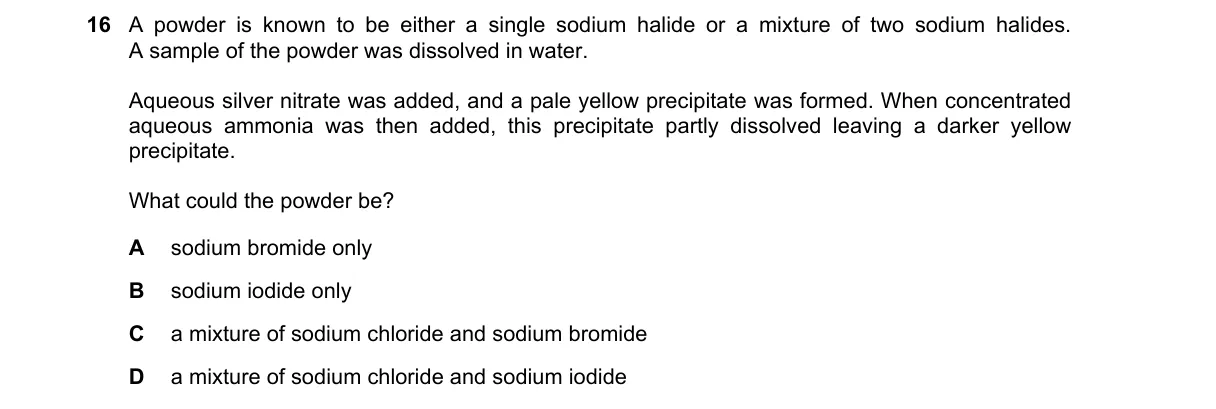
A sample of the powder was dissolved in water. Aqueous silver nitrate was added, and a pale yellow precipitate was formed. When concentrated precipitate was then added, this precipitate dissolved leaving a darker yellow. What could the powder be?
Answer choices
- Asodium bromide only
- Ba mixture of sodium chloride and sodium bromide
- Csodium iodide only
- Da mixture of sodium chloride and sodium iodide
Explanation
Halide identification via silver precipitates and ammonia solubility
Steps:
- Silver nitrate forms precipitates with halides: AgCl (white), AgBr (pale yellow), AgI (yellow).
- Pale yellow initial precipitate suggests a mixture of white AgCl and yellow AgI, appearing pale overall.
- Concentrated ammonia dissolves AgCl completely but leaves AgI insoluble.
- Resulting darker yellow precipitate confirms undissolved AgI from sodium chloride and iodide.
Why D is correct:
- NaCl and NaI yield AgCl + AgI (pale yellow mix); ammonia dissolves AgCl per [Ag(NH₃)₂]⁺ formation, leaving yellow AgI.
Why the others are wrong:
- A: NaBr yields pale yellow AgBr, which fully dissolves in ammonia, leaving no precipitate.
- B: NaCl + NaBr yields pale mix that fully dissolves in ammonia.
- C: NaI yields yellow AgI, which remains unchanged and does not dissolve.
Final answer: D
Topic: Group 17
Practice more A Levels Chemistry (9701) questions on mMCQ.me