A Levels Chemistry (9701)•9701/13/M/J/21
A Levels Chemistry (9701) — 9701/13/M/J/21, Question 10
Nitrogen reacts with hydrogen to produce ammonia. N2(g) + 3H2(g) = 2NH3(g) A mixture of 2.0 mol N2(g), 6.0 mol H2(g) and 2.4 mol ammonia is allowed to reach equilibrium in a sealed vessel of volume 1 dm3. It is found that 2.32 mol of nitrogen were present at equilibrium. Which expression will give the value of Kc?
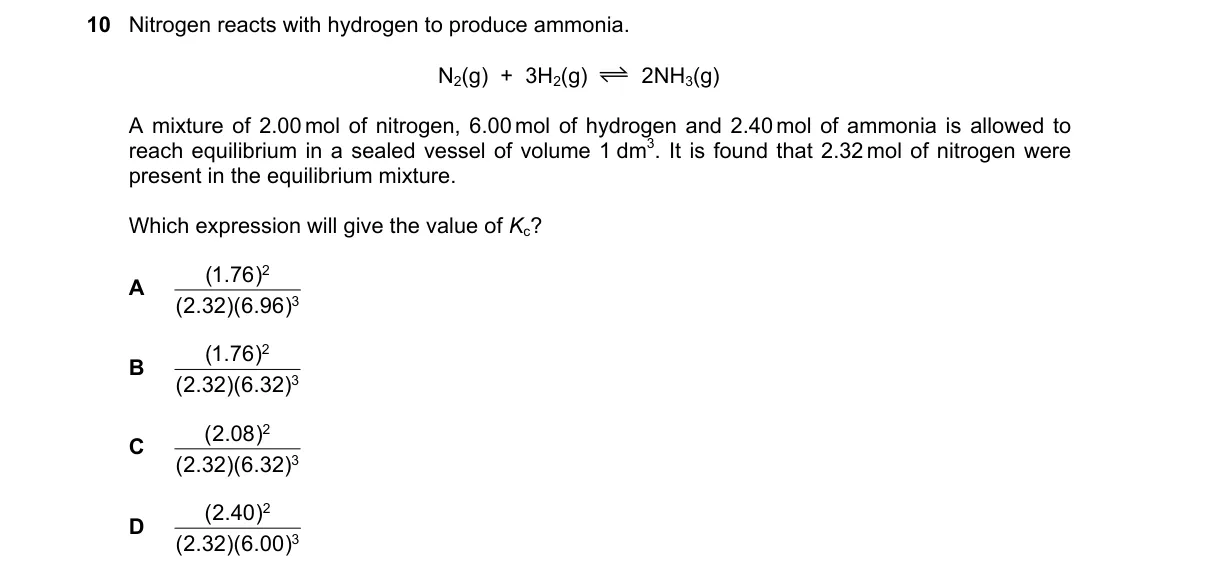
Answer choices
- A(1.76/7)
- B(32.6967
- C(32.08/32
- D(32.6/00
Explanation
Equilibrium concentrations for Kc in ammonia synthesis
Steps:
- Reaction is N₂ + 3H₂ ⇌ 2NH₃; initial: 2.0 mol N₂, 6.0 mol H₂, 2.4 mol NH₃; equilibrium N₂ = 2.32 mol.
- Reverse extent ξ = 2.32 - 2.0 = 0.32 mol; equilibrium H₂ = 6.0 + 3(0.32) = 6.96 ≈ 7 mol; NH₃ = 2.4 - 2(0.32) = 1.76 mol.
- With V = 1 dm³, Kc = [NH₃]² / ([N₂][H₂]³) = (1.76)² / (2.32 × 7³).
- Option A provides the approximated expression using 1.76 and 7 for direct Kc calculation.
Why A is correct:
- Matches Kc formula with equilibrium values and approximation of H₂ as 7 mol for simplicity in expression.
Why the others are wrong:
- B: Incomplete numerical value without relation to Kc formula.
- C: Uses incorrect numbers (3.208, 32) not matching equilibrium moles.
- D: Garbled and lacks valid equilibrium data.
Final answer: A
Topic: Equilibria
Practice more A Levels Chemistry (9701) questions on mMCQ.me