A Levels Chemistry (9701)•9701/12/M/J/21
A Levels Chemistry (9701) — 9701/12/M/J/21, Question 26
Alcohol X reacts with concentrated sulfuric acid to produce a mixture of products. Two of the products are structural isomers of each other. What could X be?
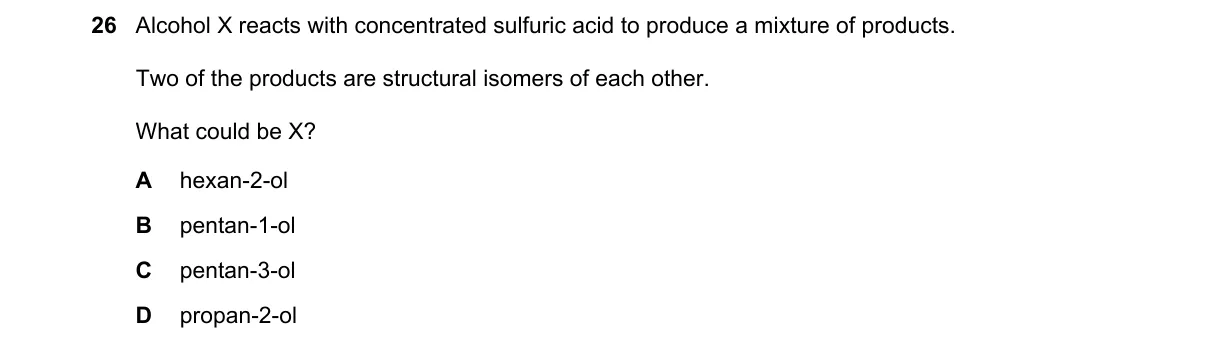
Answer choices
- Ahexan-1-ol
- Bpentan-2-ol
- Cpentan-3-ol
- Dpropan-2-ol
Explanation
Dehydration of primary alcohols produces structural isomeric alkenes via carbocation rearrangement
Steps:
- Concentrated H2SO4 dehydrates alcohols to alkenes via E1 mechanism with carbocation intermediates.
- Primary alcohols form unstable primary carbocations that rearrange via hydride shift to stable secondary carbocations.
- Deprotonation from original or rearranged carbocations yields alkenes with the same molecular formula.
- For hexan-1-ol, this results in hex-1-ene (unrearranged) and hex-2-ene (rearranged), structural isomers.
Why A is correct:
- Hexan-1-ol (CH3(CH2)4CH2OH) dehydrates to C6H12 alkenes hex-1-ene (CH2=CH(CH2)3CH3) and hex-2-ene (CH3CH=CH(CH2)2CH3), structural isomers by Saytzeff rule after rearrangement.
Why the others are wrong:
- B. Pentan-2-ol dehydrates mainly to pent-2-ene stereoisomers (cis/trans), with minor pent-1-ene; primary structural isomers not prominent.
- C. Pentan-3-ol dehydrates symmetrically to only pent-2-ene stereoisomers (cis/trans); no structural isomers.
- D. Propan-2-ol dehydrates to only propene; no isomeric products.
Final answer: A
Topic: Hydroxy compounds
Practice more A Levels Chemistry (9701) questions on mMCQ.me