A Levels Chemistry (9701)•9701/12/M/J/21
A Levels Chemistry (9701) — 9701/12/M/J/21, Question 25
Sodium methoxide, NaCH3O, reacts with 2-chloro-2-methylpropane in a nucleophilic substitution reaction. Which of the following is correct? The nucleophile is CH3O-.
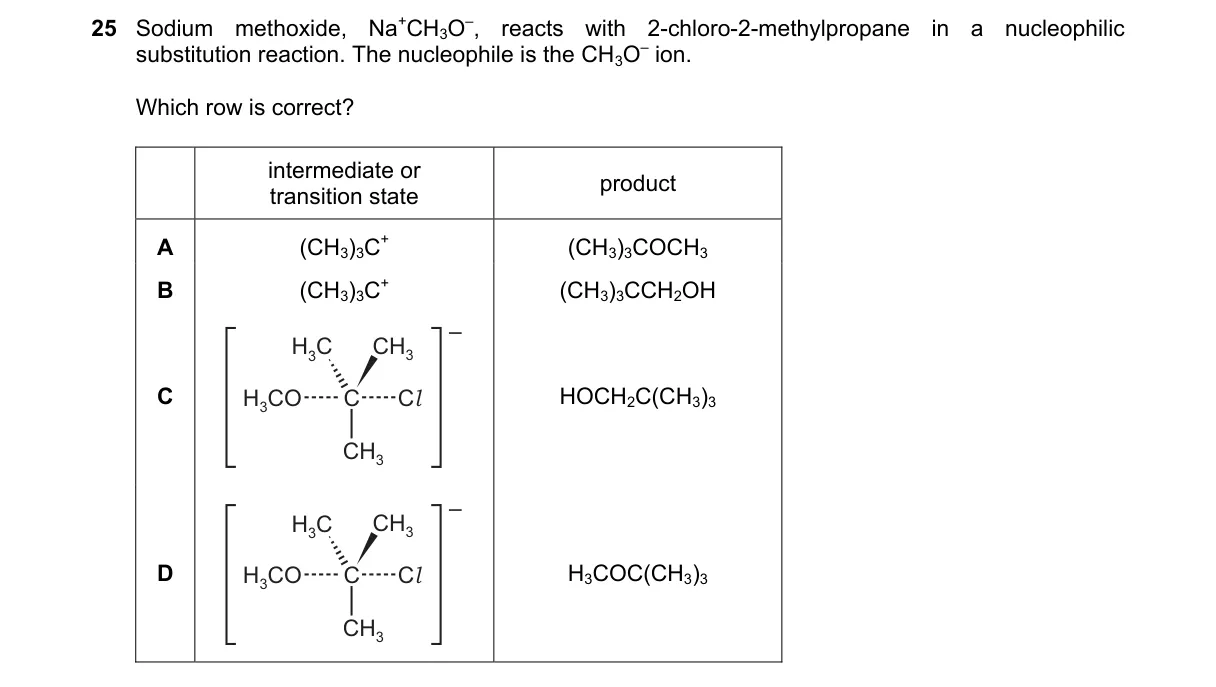
Answer choices
- A(CH3)3C- (CH3)2COCH3
- B(CH3)2CHCl- (CH3)2CHOH
- CHO-CH2-CH3 HOCH(CH3)2
- DHO-C-CH3- HOC(CH3)h
Explanation
SN1 mechanism for tertiary alkyl halide substitution
Steps:
- Identify substrate: 2-chloro-2-methylpropane is (CH3)3CCl, a tertiary alkyl halide.
- Determine mechanism: Tertiary halide with nucleophile CH3O- favors SN1 due to stable carbocation intermediate.
- Form carbocation: (CH3)3CCl dissociates to (CH3)3C+ and Cl-.
- Nucleophile attacks: CH3O- bonds to (CH3)3C+ forming (CH3)3COCH3.
Why A is correct:
- A shows (CH3)3COCH3, the SN1 substitution product where methoxide replaces chloride.
Why the others are wrong:
- B: Involves secondary halide (CH3)2CHCl) yielding alcohol, not matching substrate or nucleophile.
- C: Lists unrelated alcohols (ethanol, isopropanol) irrelevant to reaction.
- D: Garbled structures do not represent valid products or substrate.
Final answer: A
Topic: Halogen compounds
Practice more A Levels Chemistry (9701) questions on mMCQ.me